The house sale open day will be in the near future on a Saturday. Please register you interest by contacting us. Showing Start time 10am or 1pm, Finish 3pm
The Open day format:
The open day will be an opportunity to see the house and meet some of you future neighbours. It will run in two sessions, morning and afternoon.
- Arrival greeting at car park (10 am or 1pm)
- Tour of site on the way down to the house
- Tour of House, garden, workshop and community building.
- Tea/coffee and chat
- Offers received or next steps agreed.
- Arrange further visit to meet more of the community
- Read up on how the community works.
Be part of the community:
This property is part of the Hockerton Housing Project community. It includes home, carport, workshop, and share of renewables, community business, resource centre, access to the lake and other facilities.
Tenure:
999-year lease (from 1998) with annual ground peppercorn rent
Guide Price:
£600K, If making an offer please detail if you are in a chain or not and your readiness to buy.
For more details contact:
contact@hockertonhousingproject.org.uk or call 01636 816902
Click here for the brochure
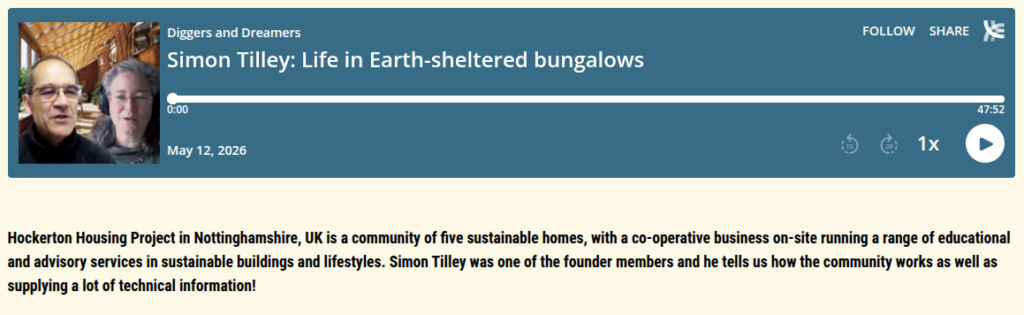
Simon Tilley talks to Kirsten about life in Earth-sheltered bungalow. “Simon Tilley was one of the founder members and he tells us how the community works as well as supplying a lot of technical information!” 48 minutes play time. Enjoy. The Diggers and Dreamers podcast is here.
Diggers and Dreamers have always been in the background of Hockerton Housing Project. They are a great resource for anybody interested in community living and I would thoroughly recommend looking at their website.
If you are interested in joining a community this is the place to start. Of course you may have already made-up your mind and are looking to join perhaps even Hockerton Housing Project and we do have an opportunity to live here. Here is the information on house sales.
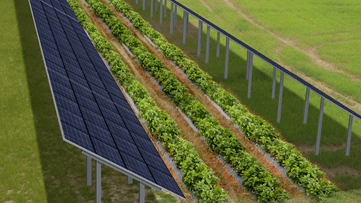
The number of large-scale solar farms is set to increase around the country over the next 10 years. As each one is planned, there is always a debate about use of land for renewables vs use of land for farming. While we also advocate for solar arrays on buildings and warehouses, this article explores the potential for a win-win situation where farming takes place underneath, or between the photovoltaic panels. This system is called agrivoltaics, and is more developed in other Western European countries and in the U.S. and East Asia than it is in the U.K.
Sustainable Hockerton commissioned Hockerton Housing Project Trading Limited (HHP) to explore the potential for a localised agrivoltaic pilot project. The research was funded by the Community Energy Fund (Midlands Hub) and HHP worked with agricultural consultant Stephen Briggs of Abacus Organic. We are seeking a lease from local farmer Simon Christy to run a pilot project next to the community wind turbine in Hockerton and use this sample site in our research.
Throughout our research, we have been in communication with Elements Green, who are leading on the public engagement around the 1-gigawatt Great North Road (GNR) Solar Project which is nearly on our doorstep. Our aim was to make them aware of the potential for food growing between the panels in case this can be factored into the GNR solar project.
Agrivoltaics systems can reduce the effect of over-drying and overexposure to sunlight in hot dry climates further south by providing much needed shade. However at our latitude we run the risk of insufficient light levels if crops are over-shielded by photovoltaic panels. Therefore we needed to explore which crops might work under such a system, and what would be the optimal spacing of the panels to allow for efficient solar capture as well as sufficient light for crops and ease of farming between them.
We are grateful to Stephen for his comprehensive and extensive review of different models for agrivoltaics and illustrative examples of how these models have been tested out with different crops in different climatic contexts. We discovered that PV panels are being developed for agricultural use on greenhouses, in open fields, and some are designed to rotate or tilt to allow tractors to pass; capture sunlight from both faces; or be translucent to enable light to pass through them.
Stephen also helped us to conclude what kind of agrivoltaics system and which crops might be best suited to our sample plot of land in Hockerton. Leafy greens or berries showed most potential.
These findings are available for download in Stephen Briggs’ report.
We have also produced a reference list of academic research on agrivoltaics, and an overview of pilot projects happening overseas and in the UK.
While there is a growing body of research on Big-Ag agrivoltaics projects, involving heavy inputs and large machinery, what we would be doing on the land in Hockerton would be much smaller scale and more suited to a market garden scale of agriculture. Small-scale food growers are often limited by the challenge of accessing land.
We noticed that while some of the bigger land owners are agreeing to lease their land to the Great North Road Solar Project (and therefore giving up on farming this land), there might be an opportunity for smaller-scale food growers to work the land between the panels without big machinery and using less environmentally impactful farming methods. Given that the margins are narrow, especially for tenant farmers, we modelled at what scale this could be feasible and which crops would suit such a system. Our findings are available here.
In the next phase of our work, we will be working with local farmer and landowner Simon Christy to seek planning permission to install a solar array on the fields next to our community wind turbine, and to design a community allotment or locally-owned soft fruit enterprise to run between the panels. Like the turbine, the plan would be for the community to buy shares in the array and for its benefits to feed into our village sustainability grant which is available year on year to each household to make their homes and gardens greener. We might also find we are eating more berries in our village!
We ran a workshop on Agri PV on 3rd December 2025. The two presentations can be downloaded.
Simon Tilley on the Sustainable Hockerton’s Demonstration Agri PV project
Stephen Briggs on the possibilities in the UK for Agri PV
The video of the event presentations is here.
We have also produced a reference list of academic research on agrivoltaics, including an overview of pilot projects happening overseas and in the UK.
Thanks to Hockerton Housing Project for hosting this event.
For more information about our research, please get in touch.
We are excited to announce that we are launching an eco venue for celebrant-led micro ceremonies at Nottingham’s Green Festival this Sunday 14thSeptember!
This has been a vision of nearly two years in the making, since one of our newest members joined and trained as a celebrant.
We have a state-of-the-art eco building situated on the edge of the lakes in the heart of our community. This is where we run our sustainability consultancy business from and make plans for the year’s food growing. We invite visitors inside the building for tour presentations and Tai Ji classes, but we have often wondered how to make more of this beautiful room. Over the years, we have held community celebrations, winter solstice meditative dances and a memorial for one of our community member’s parents. This seeded a vision to transform the room into a ceremony space and open it up to the wider community to book.
Over the past few months, we have drawn on our mutual skills and resources to co-create a unique and affordable venue option for people to celebrate an important life event in an intimate, meaningful and low impact manner, led by our in-house celebrant.
As of 14th September 2025, we are taking bookings! Please note, we will be limiting this offer to six ceremonies a year, each with no more than 20 guests. Our brochure is available for download here. Please enquire about our terms and conditions and we’d be happy to answer any questions you have.
Amongst our community members we have an ex-florist, flower growers and confetti makers, event organisers, plenty of handy men and women, artists and a graphic designer so we may be able to provide you with a few of the additional elements of your celebration as well as hosting your ceremony itself.
The ceremonies will all be led by community member and celebrant Joy Justice. Read more about Joy’s ceremonies here.
Last week we had two work experience students with us. They have written up their experience in two journals which are available here and here. It was great having the two students who worked hard and achieved a lot outside in our organic growing area.
It is great to see young people being so enthusiastic about one of the most important aspects of our lives – food growing. We wish them every success in their future endeavours. Regenerative agriculture involving people within nature based solutions is key to our sustainable future.