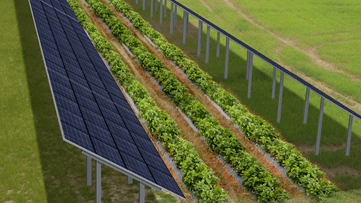
The number of large-scale solar farms is set to increase around the country over the next 10 years. As each one is planned, there is always a debate about use of land for renewables vs use of land for farming. While we also advocate for solar arrays on buildings and warehouses, this article explores the potential for a win-win situation where farming takes place underneath, or between the photovoltaic panels. This system is called agrivoltaics, and is more developed in other Western European countries and in the U.S. and East Asia than it is in the U.K.
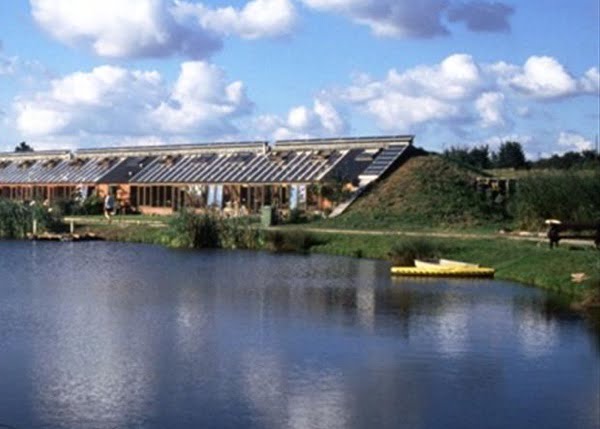
Sustainable Hockerton commissioned Hockerton Housing Project Trading Limited (HHP) to explore the potential for a localised agrivoltaic pilot project. The research was funded by the Community Energy Fund (Midlands Hub) and HHP worked with agricultural consultant Stephen Briggs of Abacus Organic. We are seeking a lease from local farmer Simon Christy to run a pilot project next to the community wind turbine in Hockerton and use this sample site in our research.
Throughout our research, we have been in communication with Elements Green, who are leading on the public engagement around the 1-gigawatt Great North Road (GNR) Solar Project which is nearly on our doorstep. Our aim was to make them aware of the potential for food growing between the panels in case this can be factored into the GNR solar project.
Agrivoltaics systems can reduce the effect of over-drying and overexposure to sunlight in hot dry climates further south by providing much needed shade. However at our latitude we run the risk of insufficient light levels if crops are over-shielded by photovoltaic panels. Therefore we needed to explore which crops might work under such a system, and what would be the optimal spacing of the panels to allow for efficient solar capture as well as sufficient light for crops and ease of farming between them.
We are grateful to Stephen for his comprehensive and extensive review of different models for agrivoltaics and illustrative examples of how these models have been tested out with different crops in different climatic contexts. We discovered that PV panels are being developed for agricultural use on greenhouses, in open fields, and some are designed to rotate or tilt to allow tractors to pass; capture sunlight from both faces; or be translucent to enable light to pass through them.
Stephen also helped us to conclude what kind of agrivoltaics system and which crops might be best suited to our sample plot of land in Hockerton. Leafy greens or berries showed most potential.
These findings are available for download in Stephen Briggs’ report.
We have also produced a reference list of academic research on agrivoltaics, and an overview of pilot projects happening overseas and in the UK.
While there is a growing body of research on Big-Ag agrivoltaics projects, involving heavy inputs and large machinery, what we would be doing on the land in Hockerton would be much smaller scale and more suited to a market garden scale of agriculture. Small-scale food growers are often limited by the challenge of accessing land.
We noticed that while some of the bigger land owners are agreeing to lease their land to the Great North Road Solar Project (and therefore giving up on farming this land), there might be an opportunity for smaller-scale food growers to work the land between the panels without big machinery and using less environmentally impactful farming methods. Given that the margins are narrow, especially for tenant farmers, we modelled at what scale this could be feasible and which crops would suit such a system. Our findings are available here.
In the next phase of our work, we will be working with local farmer and landowner Simon Christy to seek planning permission to install a solar array on the fields next to our community wind turbine, and to design a community allotment or locally-owned soft fruit enterprise to run between the panels. Like the turbine, the plan would be for the community to buy shares in the array and for its benefits to feed into our village sustainability grant which is available year on year to each household to make their homes and gardens greener. We might also find we are eating more berries in our village!
We ran a workshop on Agri PV on 3rd December 2025. The two presentations can be downloaded.
Simon Tilley on the Sustainable Hockerton’s Demonstration Agri PV project
Stephen Briggs on the possibilities in the UK for Agri PV
The video of the event presentations is here.
We have also produced a reference list of academic research on agrivoltaics, including an overview of pilot projects happening overseas and in the UK.
Thanks to Hockerton Housing Project for hosting this event.
For more information about our research, please get in touch.
Business in Southwell its time for solar.
Our local community organisation Sustainable Hockerton is hoping to expand. It has had a successful few year generating energy with the local communities support. It is run by local people that volunteer their time to direct the society. The society has been operating since 2009 initially putting up a community owned wind turbine that you may have seen if you have been here as it operates on the outskirts of Hockerton. It has subsequently bought and installed three photovoltaic roof mounted systems helping local business to reduce their carbon impact and electricity bills. The income made by Sustainable Hockerton is generated from the sale of electricity and any profit made is distributed locally to support sustainable developments. This can cover many things from funding LED light bulbs to running educational workshops on saving energy or doing heat camera surveys of houses to improve their energy performance. As an organisation they want to do more.
So what are they offering?
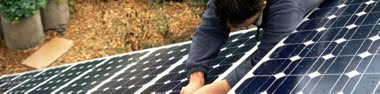
We want to help businesses in Southwell and the surrounding area to install photovoltaic panels on their roofs to reduce carbon impact, reduce energy bills and support the local community. To make a big impact they are particularly interested in helping business properties with large rooves and high electricity bills. If you run a business and are struggling with energy costs but don’t have the capital to buy photovoltaic panels, they might be able to Help. If your roof is suitable for panels, they could substantially reduce your costs and help the environment at the same time.
The ideal roof is south facing and made of steel. The ideal energy consumption pattern is one where it is mostly used during the day, so the output matches the supply. Sustainable Hockerton could manage the installation and local people are supported in their action to tackle climate change with the distribution of the profits, and educational/motivational information and workshops. The business also benefits with cheap green electricity and good integration with the local area.
If you think we could potentially work together on a roof project please contact Simon Tilley. Hockerton Housing Project manage the community renewables owned by Sustainable Hockerton.
There are many ways we can tackle the oncoming climate crises and ecological catastrophe and I would welcome other ideas and offers of help. Currently we are working on offering workshops on energy conservation and heat camera surveys to help spot energy leaks from your home.
Businesses in Southwell this is an opportunity for you to help save the planet and reduce your energy bills. Please contact Simon Tilley.
Dear Lord Callanan
I urge you most urgently to support these two amendments to the energy bill 237 and 238. I have been working in the community energy field for a long time and we need to reduce the market barriers for community groups and give them more certainty. From my experience they are key to achieving zero carbon as they not only keep the financial benefits of energy schemes’ local, they also encourage people to reduce their carbon impact. We have a lot to do to keep global warming below catastrophic levels.
Why have community energy schemes recently ground to a halt?
I believe this is largely due to current energy market and licensing rules. The recent Government interventions have been attempted but have failed to reverse the slump in new projects. The “Smart Export Guarantee”, which places a requirement on larger existing electricity suppliers to purchase power from small schemes, has no guaranteed purchase price or length of contract, making community investment almost impossible.
What should be done?
Support the amendments to the Energy Bill numbers 237 and 238.
-
A Community Electricity Export Guarantee: a right for sites that generate low carbon electricity with a capacity below 5 megawatts to export their electricity to an existing electricity supplier on fair terms (Amendment Number 237).
-
A Community Electricity Supplier Services Scheme: a requirement on existing larger suppliers to work with community schemes to sell the power they generate to local customers. Existing suppliers can charge a fee for doing this, but that fee must be reasonable (Amendment Number 238).
Here at Hockerton Housing Project we have helped many community groups in the past and if you would like to see some of these you would be most welcome.
Please see Sustainable Hockerton and its community wind turbine.
Best wishes
Simon
Mr S Tilley, CEng MEng MIMechE
Director, Hockerton Housing Project Trading Ltd
Sustainable living is important in improving the health of the community, reducing carbon emissions and lowering environmental impact. Communities can take certain steps towards living sustainably such as switching to green energy suppliers to meet their electricity needs.
Homes, businesses and communities at large have been investing more and more in ecologically sound and sustainable ways of generating the energy they use. This has resulted in increased use of green energy suppliers to power homes and businesses across the UK.
Why it’s important to live sustainably
Living sustainably plays a significant role in protecting the environment and reducing wastefulness. When communities live sustainably, they reduce their carbon footprint and the number of toxins released into the atmosphere. This improves air quality while minimising air pollution. Sustainable living also helps conserve natural resources, ensuring communities use resources efficiently. This means future generations get to have resources to use to meet their energy needs.
What’s the impact of switching to green energy suppliers?
Switching to a green energy plan means that your energy comes from a low-carbon footprint source like wind and solar. In fact, making the switch to a green energy supply can save at least a tonne of CO2 from penetrating the atmosphere every year. While this amount varies depending on the size and nature of a business or home, green energy sources have an extremely lower carbon footprint, guaranteeing lower environmental impact. If communities switch to green energy power, carbon emissions can reduce by as much as 70% by 2050.
Leading green energy suppliers in the UK
Finding a green energy tariff for your home or business has become easier. There’s a growing list of green energy suppliers offering 100% renewable electricity to meet client energy needs. These include:
- Good Energy Limited
- Ecotricity
- Click Energy
- Orbit Energy
- Pure Planet
- Octopus Energy
- Bulb
What’s the best green energy tariff?
There’s no one-size-fits-all when it comes to green energy supply. What may work for your home or business may not work for another since energy needs vary from person to person. The best green energy tariff for you depends on what metrics are vital to you, such as pricing, guidance and support.
We have been customers of both Good Energy Limited and Ecotricity for many years. Therefore, we can highly recommend them when it comes to green and renewable electricity. Their services are exemplary, and you can rest easy that their energy comes from a renewable source. Below, you’ll find an overview of these two suppliers:
Good Energy Limited
Good Energy Limited is UK’s first ever green energy supply company, bringing renewable electricity to homes, businesses and communities. The company aims to help you live sustainably by providing clean, green energy for daily use.
Ecotricity
Ecotricity is a complete vegan energy supplier, providing 100% renewable electricity. The company makes green gas from agricultural waste, ensuring clients get renewable energy from completely plant-based sources.
Ready to get started?
Here is one way to do it. The experts at Switch Plan are happy to help you navigate which green energy suppliers suit your home or business more. Simply give them a call at 0330 818 6223 for guidance and support.
Too hot to cool – can nuclear cope?
Will nuclear power save the day? Should we include nuclear energy in our future energy mix? I read today that these power plants do not cope well in hot weather which rather implies with a warming world they are not part of the solution. The Good Energy Market Update reports as follows, in the August heatwave.
France is not fairing much better than neighbouring countries, as their supply of nuclear fleets decreases even further. France relies on nuclear power, but these facilities require water for cooling. The heatwaves have meant that water is too hot to be used for cooling, meaning some plants must limit their running time. This is a further blow to the UK which typically imports excess power from France.
In Hockerton we use wind turbines and photovoltaic power to generate our energy.