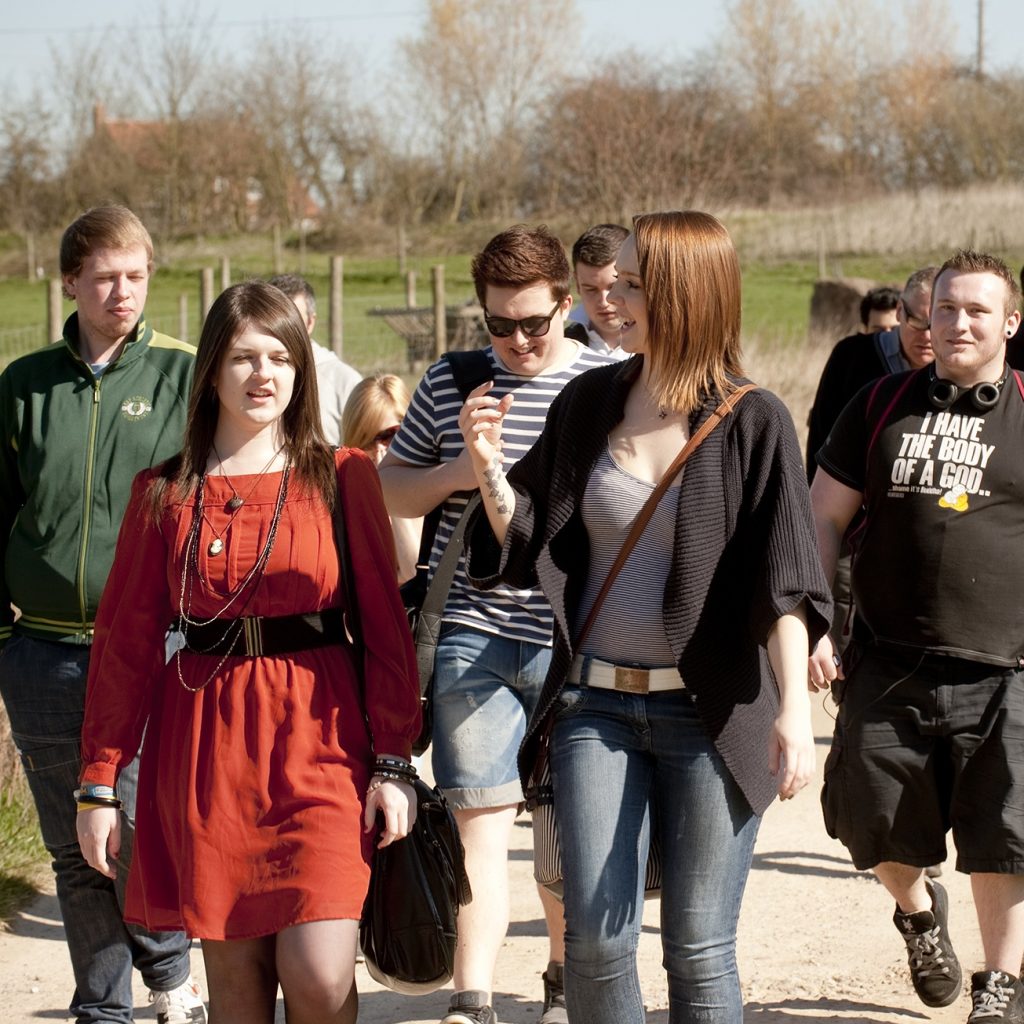
 Hockerton Housing Project has been hosting tours for over ten years, showing over 20,000 people around the Project and its homes to help them understand how homes and communities can meet the energy and environmental challenges of the 21st century.
The most frequent visitors come from our local universities in Nottingham, Derby, Sheffield, Loughborough and Lincoln but we’re keen to see more – both from other universities and from a greater range of courses. Our Project is not just about the housing or the technical infrastructure; it can be used to illustrate a range of studies including the politics of communities and the role of sustainability in health services.
Feedback suggests a visit to us can really inspire students…
Thanks again for a great day and for inspiring my students!
Reader in Environmental Geography, Geography Department,University of Leicester
It was a super experience and the students were buzzing all the way home.
Associate Professor, School of Politics and International Relations, University of Nottingham
Many thanks for another superb visit. It gives the students a real insight into the options for more sustainable living and really gives them something to think about.
Queen Elizabeth High School for Girls
I’d just like to thank you personally for inviting us in your homes and inspiring future generations with your amazing work. It was such a productive experience as we got to see everything we’ve been taught in our module in real life. I thought it was all just theory but to see it up and running and so successful gave me great joy.
Engineering student, Loughborough University
We’ve prepared a short guide to these visits for lecturers and teachers, and are keen to hear from lecturers how you think we could help you bring sustainability to life in your classroom or through a visit to Hockerton Housing Project.
 When Jenny, who grew up at Hockerton Housing Project, left to take up a place at University we thought it was an opportunity to ask her what contrasts she noticed between HHP and University life!
I recently left Hockerton Housing project to go to the University of Nottingham to study for a Masters degree in Biology.
This move provided a unique opportunity to document my experience and the differences and similarities that I noticed between home and University. It is difficult to compare two such establishments, an eco community of five households I have lived in for fourteen years and halls of residence housing I have lived in for a year which houses around 350 students.
Clearly these living arrangements are on very different scales. However, I will not so much try to compare them but discuss the positive and negative environmental impacts of the University that I noticed in my first year.
On moving into the halls of residence I first noticed that there were photovoltaic cells on the roofs and recycling bins in each block of rooms, making it easy for the students to sort their rubbish. I also noticed that students make good use of public transport as well as choosing to cycle and walk rather than driving. This is something that maybe mostly motivated by money and the absence of parking spaces for students on the campus but which nonetheless contributes to the greenness of the University and students.
Communal living at university lessens the amount of autonomous decisions that you have. For instance regulating lighting and heating in communal areas is difficult. Communal living at University presents the obvious issue of food waste, especially in catered halls where hundreds of students are fed at each meal time. Food is thus cooked in bulk and waste is inevitable. It also makes it impossible for students to choose the source of their food. These are issues which would be hard to resolve. At Hockerton Housing Project families are required to spend part of their week growing food on an organic allotment to supply locally grown food and thus reduce the carbon emissions associated with food production.
For many students it is true that being eco-friendly is not a priority. Students live busy lives and have, not only University studies to complete, but also have to learn to live independently. This is particularly apparent in first year when fending for oneself and coping with living away from home is the main focus!
A significant aspect of University is that it brings together people from all different walks of life. However this also highlighted to me the difference between my and my fellow students upbringings. I was able to access a vast amount of environmental knowledge and understanding when I was growing up, something that many students did not have the opportunity to experience. Thus for most of them coming from a background where recycling is not undertaken and where space heating is used all year round, it must be difficult to see what can be achieved on a day to day basis.
It is clear that the university is involved with environmental issues. Having been asked to write this article I decided to research into the environmental efforts of the University. The University of Nottingham is one of the leading green Universities and is currently 2nd in the UI Green Metric of the world’s leading green Universities. It has a group called the ‘Young Greens Society’ which is affiliated with both the Young Greens and the Green Party and raises awareness of sustainable issues and the Green Party.
 Also Nottingham University School of the Built Environment has a number of exemplar low CO2 emission buildings which are on the campus and provide an opportunity for academic research and evaluation. Students on courses within this Dept. are also regular visitors to Hockerton Housing Project.
It is clear that the University makes an effort to be environmentally friendly by producing electricity, providing students with recycling facilities and through its academic efforts. It would be interesting to consider how the University could make sustainability more central to their students life experiences and the impact this could have on the future lives of its graduates. Student welfare is central to the University’s but this service seems to focus primarily on financial, health and academic dimensions and does not prioritise sustainability…..is this a missed opportunity???
If you would like to visit Hockerton Housing Project with a group of students, then please contact us
Jenny Rajan
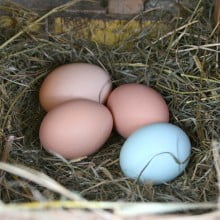
The Daily Express has featured Hockerton Housing Project to illustrate the benefits of sustainable co-housing developments…
As my car bumps along the potholes of the dirt track, the setting that unfolds before me is idyllic. Sheep graze lazily in the field to my left and a dozen or so chickens cluck like gossiping washerwomen as two young children excitedly collect eggs from the henhouse.
In the distance there are beehives while ahead ducks glide effortlessly across the still surface of a lake as a heron swoops in. Nearby a couple of men wearing fleeces are engrossed in conversation.
Though you may imagine that I’ve arrived in a sleepy country park or farmyard this in fact is a snapshot of life at one of the many so-called co- housing projects that are springing up all over Britain…
It’s an unconventional way of life that certainly wouldn’t be right for everyone but it’s impossible not to admire what they stand for at HHP. I can’t deny that as I drive back up the dirt track and out into the rat race again, I can feel my own stress levels kick back in.
Read the full feature, including an interview with residents Bill and Lou, here.
 Hockerton Housing Project are proud to announce that Luke Tilley, who has grown up at the project has been made captain of the Junior British Climbing Team. Luke is currently Junior British Champion for his age group and is now training hard to prepare for the World Championships in Imst (Austria) this summer.
Luke takes sustainability seriously and tries to minimise his carbon footprint despite his travel to European competitions. He is sponsored by Evolv, who are the first climbing shoe manufacturer to use a recycled rubber compound, and Prana, a climbing clothing company which powers its factory with wind energy (Natural Power Initiative).
From all at HHP, we wish Luke good luck in his future competitions and wisdom in his environmental choices!
We always welcome feedback from visitors, but rarely get as full a review as this…
I am in the Oil Industry and a pilot neither, I admit, the greenest of occupations. My Wife and I faced a major renovation and it seemed sensible to come to listen and learn.
What did I learn?
-A Hockerton house is not a ‘magic’ house.
-Don’t stick a B&Q windmill on top of your house
-It is highly unlikely many of us could achieve what Hockerton has, but, we can all do something.
-the first step is to insulate, don’t waste energy.
-use ‘airlocks’
What do I know?
-conventional energy cost are going to rise.
-If I had the last barrel of crude oil in the world , I would not just burn it.
-If we don’t do something about carbon, its going to get hot and whilst it probably won’t affect conceited (very lucky) little me it is going to hurt those most in need. Millions of them.
-There are positive things we can do and very simple behaviours we can adopt that help; just that little bit.
So what did we do?
-Insulate! Get the house up to modern standards and prevent the energy haemorrhage.
-Build ‘airlocks’ and adopt the rule of Arctic living; we don’t open one airlock door until we have closed the other.
-Underfloor heat. Small delta T over a very large area is very efficient. Reduce to a minimum heating in areas not in use. [Here delta T is the temperature difference across two surfaces, how does it work]
-Build a conservatory to capture the heat from the sun. Isolate it in Winter or when there is no sun.
-Install GSHP: We yet to have long term use stats but advertised efficiency of 1:4 seems common sense. (Although at HHP our experience has not been so good, find out here.
-install a modern woodburner and have it ‘shared’ between two rooms by a little clever design. How can something so simple be so efficient?
-configure the kitchen to make the most of recycling so that it overcomes lazy human nature
-install a quooker; ie boil exactly what you use. No waste. (again…not sure of the stats over the long term but we will see)
-compost, harvest rainwater , grow our own and keep chickens. In terms of cost time and effort , no it is not effective but, it is a pleasure, tastes great (eggs and food, not the compost) and helps just that little bit.
-develop a ‘stingey’ attitude and aim to use and re-use everything. After a short while it becomes a habit.
In conclusion:
A visit to Hockerton is inspirational and motivational. We are doing a little bit as a result.