Back in June the Government published its most detailed research yet on electricity use in the home: Powering the Nation 2.
It’s returned to our minds with recent coverage of EU rules on vacuum cleaners.
We understand some people are concerned, but power consumption and performance are 2 very different (eco) kettles of fish, a case well made by this rebuttal from the EU.
A third dimension is creeping into the energy conscious consumer’s priorities alongside power use and performance: time. New time of use tariffs will emerge over the coming decade to try and manage down use during peak demand hours (4pm – 8pm) to avoid the higher financial and environmental costs of flexible supply. Alongside the risk that new tariffs will be no clearer than Economy 7, which leaves about 40% of users out of pocket, there is the risk that consumers will simply pay higher bills as the price for flexibility.
So, here’s the good news from that Powering the Nation report:
“More efficient appliances would make a bigger difference to the peak load than ‘load-switching’ per se”
This is why we need regulations on energy efficiency. Regulations address a lack of information in the market, and in this case they address a (highly understandable) lack of knowledge amongst consumers of the relationship between power use and performance. Of course, it takes time for those efficiencies to be felt in every home, with the potential need for help for fuel poor households, so in the meantime here at Hockerton Housing Project we are timing our flexible use such as our immersion heaters, white goods and the EV to match peak solar generation or off-peak supply hours, and are planning to investigate how to better match use to generation.
And finally, one household has got a cordless vacuum cleaner, one example of how batteries could transform the way and times we use energy. But it’s so useful that, whilst its energy use can be timed to cut financial and environmental costs per kWh, the total energy use could be much higher because it’s so handy. It’s never simple is it?!
This year we’ve planned a more diverse planting scheme in our polytunnel, and it’s paying off. For the past 8 years we’ve had two tunnels, with a rotation of tomatoes in one and a range of vegetables in the other; but a poor tomato harvest and a new year’s resolution led to a review of our approach.
The ‘tomato tunnel’ was always a sight to behold: two narrow paths leading through a veritable jungle of yellow and red fruits, large and small. But last year the plants suffered from mildew, affecting both the yield and flavour. As we are organic we don’t use fungicides, and as we can’t control the heat, the only solution open to us was to see if we could improve ventilation by increasing the distance between plants.
Our planning in early 2014 was also affected by a new year’s resolution to make more of the tunnels, having moved them next to each other within easier reach of the homes. We wanted to extend the season for peas and beans, and see what impact the extra warmth could have on a range of brassicas and celeriac.
So far, so good. The tomato tunnel is in full production: it is still a jungle but with more shafts of light and that all important air flow. We also found room for a cucumber plant or two, and the additional spacing has left room for underplanting of peppers and chillis, celeriac and a mix of herbs, most notably basil.
Tunnel two has gone through the greatest change. We’ve learned that the tunnel extends the broad bean season from a fortnight glut to four productive months, and harvested onions, garlic and a range of brassicas, impressive in size, looks and of course taste.
With those early crops now cleared as outdoor planting takes over, we are starting to harvest the first of the sweetcorn and are gearing up for winter with more peas, beans, brassicas, and carrots. So much for August being the month you just sit back and enjoy your garden!
If you’re thinking of getting a polytunnel or are reviewing your planting, we recommend taking a look at First Tunnels, their monthly planting advice is particularly helpful. And for organic seeds and seedlings, try Delfland Nurseries. The ability to book deliveries months in advance is particularly useful if you have limited time, space or patience to raise seedlings, particularly the trickier ones!
And if you fancy visiting our tomato jungle, along with a tour of one of our eco-homes and the wider site, please join us on our next Sustainable Living tour on 20 September.
We are often asked why we settled on a group of five homes when planning the development at Hockerton. There are practical reasons such as the size of the plot available, and planning requirements such as the need to incorporate street lighting in larger developments. But there is also a social reason. The following excerpt from OpenLearn LabSpace on team dynamics is a helpful summary…
How many people in a team?
Does the task need a lot of people doing the same task (for example, an advice centre) or a small, expert team addressing different parts of the task (for example, writing new information leaflets)? The size of the team needed will be an important consideration. The larger the team, the greater the potential variety of skills and knowledge, but as the size of the team increases each individual will have fewer opportunities to participate and influence proceedings. The size of a team is therefore a trade-off or balance between variety and individual input. A team of between five and seven people is considered best for the effective participation of all members, but to achieve the range of expertise and skills required, the group may need to be larger. This brings with it the challenges of how to manage and supervise a large team. In health and social care, multi-organisational teams may be large given the need to ensure representation from different organisations required to plan and deliver a particular service or address an individual service user’s case.
Homogeneous groups, whose members share similar values and beliefs, may be more satisfying to work in and may experience less conflict, but they tend to be less creative and produce greater pressures for conformity. In contrast, heterogeneous groups, whose members have a wider range of values and beliefs, are likely to experience greater conflict, but they have the potential for greater creativity and innovation.
Our shared values and beliefs certainly deliver less conflict, but we’ll leave it to you to decide whether it also means we are less creative!
We’re delighted to announce a new programme of seasonal and sustainable workshops for children and for adults, to give people the chance to get in touch with nature, recycle old furniture and decorate their homes. Take a look at our events page to see what’s on offer, and get in touch if you are a course provider looking for an inspiring eco venue to host your courses.
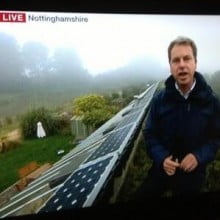
Today BBC Breakfast used Hockerton Housing Project (HHP) as the backdrop to their coverage of the latest Intergovernmental Panel on Climate Change’s report.
The IPCC has found that climate change is having a bigger impact than previously expected, and that temperature rises continue though they are slower than expected.
Science aside, HHP was delighted to be asked to show why sustainable living makes sense whatever your views on carbon and the climate.
The live broadcasts featured the zero carbon homes and renewable energy systems to show how action on carbon helps reduce energy bills, aids energy security, and galvanizes community spirit.
Simon Tilley talked through life at Hockerton Housing Project, “Our mission at HHP is to bring sustainability to life and what better platform than BBC Breakfast with its 7 million viewers? We were probably chosen because our homes look and feel different but the reality is that every home can become more sustainable: our approach to energy efficiency works in a townhouse, as seen in Southwell’s autonomous house; renewable energy is now more accessible thanks to the feed-in tariff and local community schemes; and it has been fantastic to see the resurgence of food-growing and the allotment movement.”
His daughter Naomi gave the most powerful line though. When asked by the presenter if she felt confident about the future, she replied “I’m not confident, I’m scared”. She later admitted that part of the fear was down to being interviewed live on national TV, but the line helped the coverage look beyond the current ‘debates’ to what we need to focus on – the legacy we leave for our children.