Hockerton Housing Project is excited to announce it has released its own housing standard fit for the future world of zero carbon houses. It is called the Hockerton House Performance Standard and outlines the requirements that houses will need to be built to in order to achieve a sustainable low impact world. Unlike the Passivhaus standards these are free to use and go far beyond what Passivhaus can achieve. They are there to inspire!
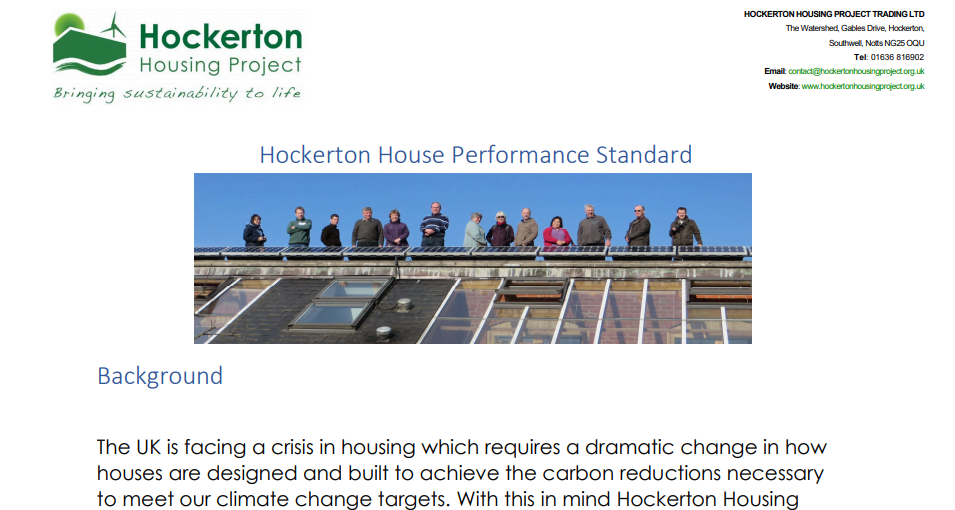
Minister for Housing Nick Raynsford visiting Hockerton Housing Project

Since the visit of the Minister for Housing Nick Raynsford at our opening we have been pushing the boundaries of construction. Our latest development of nine houses is taking shape with the walls going up in Howgate Close, Eakring with a predicted SAP score of 142! Jerry Harrall is delivery the project and writing Howgate Close, blog.

Howgate close foundations
The UK is facing a crisis in housing which requires a dramatic change in how houses are designed and built to achieve the carbon reductions necessary to meet our climate change targets. With this in mind we are proposing standards of construction to inspire people to construct very high-performance houses factoring in embodied energy and within sustainable communities. The lifestyle of the people living in houses affects emissions of carbon significantly so cannot be ignored. A well-engineered house and designed community space will help inspire them to reduce their carbon emissions. Inspiration can lead to action given the right environment.
The imbedded House Performance Standards are performance based to allow individual designers and builders to create their own solutions. This should encourage creativity and enable future solutions to be incorporated in the finished houses.
These performance standards have been inspired by Dr Robert Vale, Professor Brenda Vale, Mr Nick Martin and the practical experience of the members of Hockerton Housing Project since 1993. They have drawn on General Information Report 53 produced for the Department of Environment Transport and the Regions by the Building Research Energy Conservation Support Unit. More recently the Leti “Net Zero Operational Carbon” targets have pushed us!
There are five subsidiary standards:
- Hockerton-Zero,
- Hockerton-Heat,
- Hockerton-Embodied
- Hockerton-Water,
- Hockerton-Community
Combining these five standards will create houses fit for the future.
If you are a lecturer or student and want to design your own tour find out more here.
One of our longest-standing residents reflects on her time at HHP….
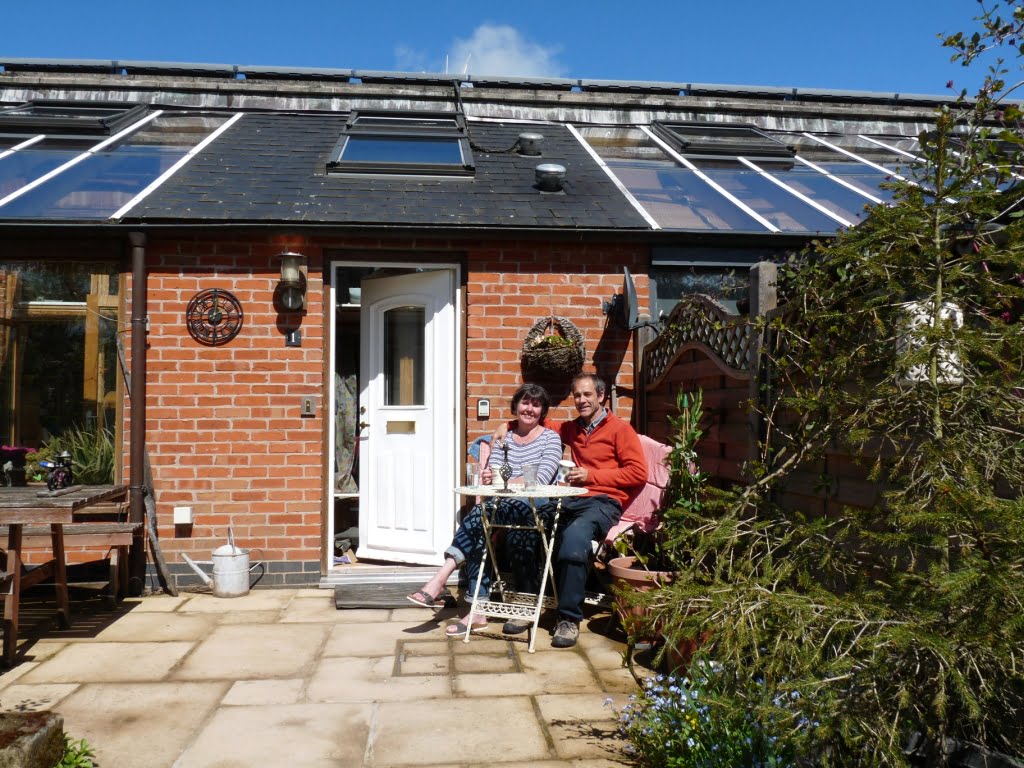
This is the 20th year since we joined HHP. We had recently returned from volunteering in Namibia and felt that sustainable development needed to start in the affluent West. We had relocated to Nottingham as I had a medical job there and Simon was looking after our small son Luke and looking for some way of using his engineering skills and doing it sustainably. By chance he came across HHP who were looking for a family to join them and the rest is history!
In those days (1995) I think we were more about sustainable and autonomous housing and climate change was not such an obvious issue but of course that has all changed and Simon now spends a great deal of time thinking about Renewables although our core business of demonstrating and promoting zero energy and sustainable housing continues and has lost none of its relevance today.
We moved into our brand new house in February 1998 after 18 months in a caravan with by then 3 small children. Simon had contributed to the self-build and being on site allowed him to juggle the family and building whilst I went off to a warm comfortable hospital every day! Our neighbours at the time were in a similar position which allowed some complementary childcare and a lot of mutual support!
Over the 20 years the Project has grown in so many ways. We had not realised the amount of interest it would generate with about 30,000 visitors, a significant amount of media interest and a small business that has continued to promote sustainability and provide employment for some of the residents.
Families have come and gone and we are now the last original family. Our children are grown up and Flo who was born when we were in the caravan is doing A levels and considering her future. It is perhaps not surprising that Luke is studying permaculture and small-scale organic horticulture in Leeds and Naomi is down in Falmouth studying Environmental Science. Their childhood in this wonderful site has been spent in the woodland and lake, in a small community of children and adults where they have had the freedom to explore and learn in safety. Parenting them has been easy. It is a pleasure to see other small children growing up and enjoying this space that we have helped to create.
As old families have moved on it is sad to lose that collective memory of the first days and the struggle to get planning permission and the houses built. We will be the last to remember why we did things this way or that and why that particular phrase in the secondary rules was written that way. But new families have brought in fresh energy and ideas and keep the direction of the business gently changing depending on interest, skills and available time.
Simon and I have no plans to leave and this lifestyle and place is perfect for us. The apple trees are in blossom and the new plants in the polytunnel are thriving and ready to go out. As the spring sun floods the conservatory after earlier rain, I am as excited as ever to throw open the doors to the bedrooms and know that the temperature in the house will stay in the low 20s until November.
After 20 years here our lives will change as the children leave and we have a bit more time for ourselves. More time to spend on the land, more time to sort out 20 years of childhood paraphernalia and more time to sit in the kitchen, conservatory, garden or lakeside depending on the weather and the season just enjoying this extraordinary place we helped to create!
Helena
We know we’re lucky having access to nature on our doorstep, and the ability to help it thrive, so we’re very keen on The Wildlife Trust’s campaign for a Nature and Wellbeing Act which would give everyone – particularly children – access to nature and improve its status in national and local government decision-making.
The ambition of the Act, and the delivery mechanisms, have been likened to the Climate Change Act, and has its own implications for our response to the climate change – by building our local environment’s resilience.
Support the Act for Nature: bring about the recovery of nature in a generation, for the benefit of people and wildlife

But we don’t like to just sign a petition if we can also take some personal action.
We’re reviewing our land use, as we’ve recently renewed our agricultural tenancy, and our first job is to start planting hedges to balance our agricultural use of the land with our aim of improving the site’s biodiversity. This balance is core to the land management plan that supported our original planning application and s106, but more than that these wildlife corridors support the natural environment that in turn supports our health and wellbeing.
Woodland Trust has tree-planting packs available for others to develop these natural spaces in their school, community or farm.
We are often asked why we settled on a group of five homes when planning the development at Hockerton. There are practical reasons such as the size of the plot available, and planning requirements such as the need to incorporate street lighting in larger developments. But there is also a social reason. The following excerpt from OpenLearn LabSpace on team dynamics is a helpful summary…
How many people in a team?
Does the task need a lot of people doing the same task (for example, an advice centre) or a small, expert team addressing different parts of the task (for example, writing new information leaflets)? The size of the team needed will be an important consideration. The larger the team, the greater the potential variety of skills and knowledge, but as the size of the team increases each individual will have fewer opportunities to participate and influence proceedings. The size of a team is therefore a trade-off or balance between variety and individual input. A team of between five and seven people is considered best for the effective participation of all members, but to achieve the range of expertise and skills required, the group may need to be larger. This brings with it the challenges of how to manage and supervise a large team. In health and social care, multi-organisational teams may be large given the need to ensure representation from different organisations required to plan and deliver a particular service or address an individual service user’s case.
Homogeneous groups, whose members share similar values and beliefs, may be more satisfying to work in and may experience less conflict, but they tend to be less creative and produce greater pressures for conformity. In contrast, heterogeneous groups, whose members have a wider range of values and beliefs, are likely to experience greater conflict, but they have the potential for greater creativity and innovation.
Our shared values and beliefs certainly deliver less conflict, but we’ll leave it to you to decide whether it also means we are less creative!

Let’s make stuff
We’re delighted to announce a new programme of seasonal and sustainable workshops for children and for adults, to give people the chance to get in touch with nature, recycle old furniture and decorate their homes. Take a look at our events page to see what’s on offer, and get in touch if you are a course provider looking for an inspiring eco venue to host your courses.
26 October Magic up your own broom!
23 November Kids’ Christmas crafts
8 December Weave a willow wreath
13 December Luxury wreath workshop