I am moving on from my lecturing duties at Nottingham Trent University. There is now an opportunity for someone to take on this fulfilling role and the universities advertisement for it is below. Click for further the vacancy details. Please contact HHP if you want to discuss my experience of the work. Simon Tilley.
Nottingham Trent University
Hourly Paid Lecturer in Renewable Energy Technologies
Brackenhurst Campus
Job reference: 011117
Location: Brackenhurst Campus
Closing date: 11/12/2022
Salary : See special conditions
Employment type: Hourly paid/casual staff
Team: Environmental Science
School / Directorate : School of Animal Rural & Environmental Sciences
Special Conditions: £44.45 per direct teaching hour. This includes the following elements: teaching, preparation and marking of the scheduled programme of work. (A flat rate of £17.78 will be paid for completing one of the above elements of the schedule.)
The School of Animal, Rural and Environmental Sciences is an exciting multi-disciplinary environment for learning, teaching and research. We are seeking hourly paid lecturers for a range of courses within the Environmental Science Department. Our portfolio of undergraduate and postgraduate courses comprises subjects such as Horticulture, Geography, Conservation, Food Science and Environmental Science.
We are seeking to appoint an Hourly Paid Lecturer in the following area:
Renewable energy and energy policy
In addition to appropriate knowledge and experience, you should possess excellent communication and presentation skills and a willingness to contribute flexibly to teaching and associated duties on undergraduate courses in this area.
We need skilled lecturers to support students through delivery of a range of courses. You will work under the direction of the Head of Department and Course Leaders to deliver high quality teaching and learning to undergraduate students. Duties will include preparation, delivery and marking of work. You will be expected to deliver lectures and practical sessions, seminars and tutorials and may be asked to contribute to other areas of the School’s activities.
You will be able to demonstrate excellent interpersonal skills and have the ability to communicate ideas of a complex or technical nature to students effectively using a variety of teaching methods, have detailed knowledge of the particular subject area through significant teaching, and / or relevant industry experience.
If you have any specific queries in relation to these positions, please contact: Julia Davies 0115 848 5242
Interviews: Given the nature of these roles, interviews will take place throughout the year. The Head of Department or nominated colleague will be in touch following the submission of your application.
Please note this role does not meet the UK Border Agency requirements for sponsorship. The University is unable to apply for sponsorship for any applicant not eligible to work in the UK and therefore we cannot progress applications from candidates who require sponsorship under the Points Based Immigration System.
New homes and buildings in England will have to produce significantly less CO2 under new rules announced by the government to help the country move towards net zero. Published 15 December 2021
Changes to building regulations will help UK deliver net zero
New homes will have to produce around 30% less CO2
Important step for industry ahead of Future Homes and Buildings Standard in 2025
New homes and buildings in England will have to produce significantly less CO2 under new rules announced by the government in December 2021 to help the country move towards net zero.
Under the new regulations, CO2 emissions from new build homes must be around 30% lower than current standards and emissions from other new buildings, including offices and shops, must be reduced by 27%.
Heating and powering buildings currently makes up 40% of the UK’s total energy use.
Installing low carbon technology, such as solar panels and heat pumps, and using materials in a more energy efficient way to keep in heat will help cut emissions – lowering the cost of energy bills for families and helping deliver the UK’s climate change ambitions.
All new residential buildings, including homes, care homes, student accommodation and children’s homes, must also be designed to reduce overheating, making sure they are fit for the future and protect the most vulnerable people. Improvements to ventilation will also be introduced to support the safety of residents in newly-built homes and to prevent the spread of airborne viruses in new non-residential buildings.
The changes announced to the government’s Building Regulations, which set the standards in England for the design, construction and alteration of buildings, follow a public consultation and will come into effect from June 2022.
They will raise standards and are an important step towards a cleaner greener built environment, paving the way for the Future Homes and Buildings Standard in 2025, which will mean all future homes are net zero ready and will not need retrofitting.
Housing Minister Eddie Hughes said:
Climate change is the greatest threat we face and we must act to protect our precious planet for future generations.
The government is doing everything it can to deliver net zero and slashing CO2 emissions from homes and buildings is vital to achieving this commitment.
The changes will significantly improve the energy efficiency of the buildings where we live, work and spend our free time and are an important step on our country’s journey towards a cleaner, greener built environment.
Further information
Alongside amendments to the Building Regulations, there are 5 new Approved Documents:
There will be a 6 month period before the new regulations come into force on 15 June 2022. Transitional arrangements are in place which mean that if a building notice, initial notice, or full plans for building work are submitted to a local authority before 15 June 2022, then provided the building work commences by 15 June 2023, work on that individual building is permitted to continue under the previous standards.
As well as setting out measures for the 2021 uplift to the Building Regulations, the government response to the Future Buildings Standard consultation also sets out plans for the implementation of the Future Buildings Standard from 2025. This includes plans to start a full technical consultation on the FBS in 2025.
Over the past 18 years we’ve hosted thousands of students of energy, water, and environmental sciences but increasing number of visits from other strands of academia is both heartening and fascinating.
Recently we hosted Nottingham University’s School of Mathematics, as part of their work on MASS: ‘Modelling and Analytics for a Sustainable Society‘, and are delighted to hear we were cause for both inspiration and optimism.
“HHP showed me that I was wrong and it is possible to live in a (much more) sustainable way without diminishing our quality of life. I would even argue that the ‘Hockerton lifestyle’ might even be far more enjoyable than the busy, consumption-focused lifestyle most of us enjoy”
“Highlights on the day included “the house tour as we got to see how it all came together in reality”, “the aquaponics, as this was not something I was aware of before, the conservative and careful use of water (e.g. less filtered water for showering and the toilet), their own water filtration systems and being off the grid for water”.
“[we] were all surprised at the toasty warm floor despite the absence of any central or secondary heating!”
You can read their views in full here, or contact us to find out how we can bring your area of work or study to life for your students, colleagues or clients.
Every 3 – 4 months we read our 50 power and water meters to check how we are doing in terms of consumption, generation and export.
Each household pays for their share of consumption relative to use, with any income from the export of renewable energy shared equally between us.
The resultant figures help us remain aware of our use, not least because we see it relative to (or in competition with?!) our neighbours. It also reminds us how well these houses perform. This can become easy to forget when the house is your home – until heatwaves like this week, when we could feel the difference as the thermal mass soaked up any heat that made it through shaded windows.
* Our average daily energy use was around 23% of a standard house (per house, not incl the garages).
* We exported 38% of what we generated, compared with 48% in the winter
* We earn around 4p for a kWh exported but pay on average 7.5p per kWh we use, so over the last 4 months we’ve missed out on energy worth £145.
* In the last 4 months we’ve generated the equivalent of 95% of our total household use (not including our shares in our community-owned wind turbine of course).
* And we are using 260 litres of water a day per house on average. Potable: non-potable is 1:11. This is a similar ratio to that in the first quarter but an increase overall. Average usage per person is 82 litres, compared with Code for Sustainable Homes Level 5 and 6 target of 80 litres – perhaps due to higher number of washes during peak vegetable gardening season!
This autumn, HHP is racing against the clock to install further solar PV roofs funded by local community energy co-op Sustainable Hockerton.
The plan is to install two roofs on local businesses – one of 10kW and a further one of 27kW. The businesses benefit from lower cost power, Sustainable Hockerton members benefit from continued returns from their investment, and the community benefits from a village sustainability fund.
These new installations will be funded by the co-op’s income from its 225kW wind turbine, potentially with some top-up loans from its members, and will help further diversify the renewable energy systems in our parish.
The clock is, as many of you will know, ticking. The Government plans to substantially cut the feed-in tariff and, as of 1 October, removed the ability to pre-register schemes for the feed-in tariff, removing the certainty that community schemes need to raise investment. These cuts appear far too big and far too early, whilst the attack on investor certainty pushes up costs – which is no way to help reduce energy bills in the long-term. We have sadly also begun to see the impact of specific cuts and a wider policy vacuum on jobs, with the loss of an estimated 1000 jobs at Mark Group and Climate Energy.
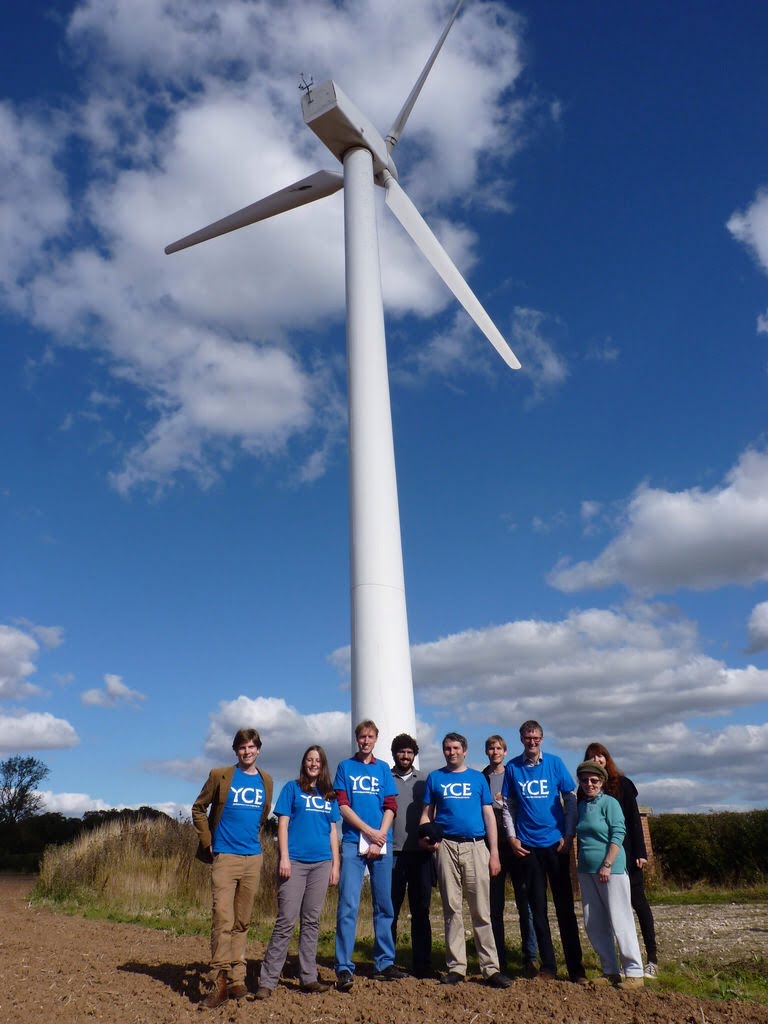
We can only hope this attack on renewables is a last gasp from a system historically reliant on the fossil fuel industry. Interest in our approach continues to engage and inspire other communities (pictured above are York Community Energy on a recent visit); and at a crucial time in the run up to Paris talks, the climate now has the Pope, Barack Obama, the governor of the Bank of England and Nanny McPhee firmly on its side.
It is, to say the least, disappointing that the UK Government is no longer leading the green agenda, but this is a global challenge and, as the business world opens its eyes to the high risks it faces, it feels like the balance is shifting.
If you want to find out more about what we’ve achieved at the street and community level, our next Sustainable Living tour is on Saturday 7 November.