Have we ever mentioned how thermal mass keeps our homes warm in winter and cool in summer?
No doubt if you have visited us you’ve heard the stats and felt the benefit, but a day like today makes the benefits all the more evident.
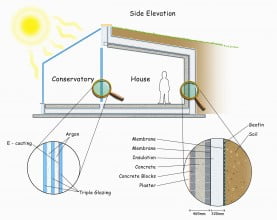
The thermal comfort of our homes is met through the application of three key design principles:
Thermal mass to store heat in the summer months to keep the home cool in summer and warm in winter
Passive solar gain to reduce the need for space heating and artificial lighting
Super-insulation and buffer zones to provide a reduced temperature gradient between the inside and outside of homes.
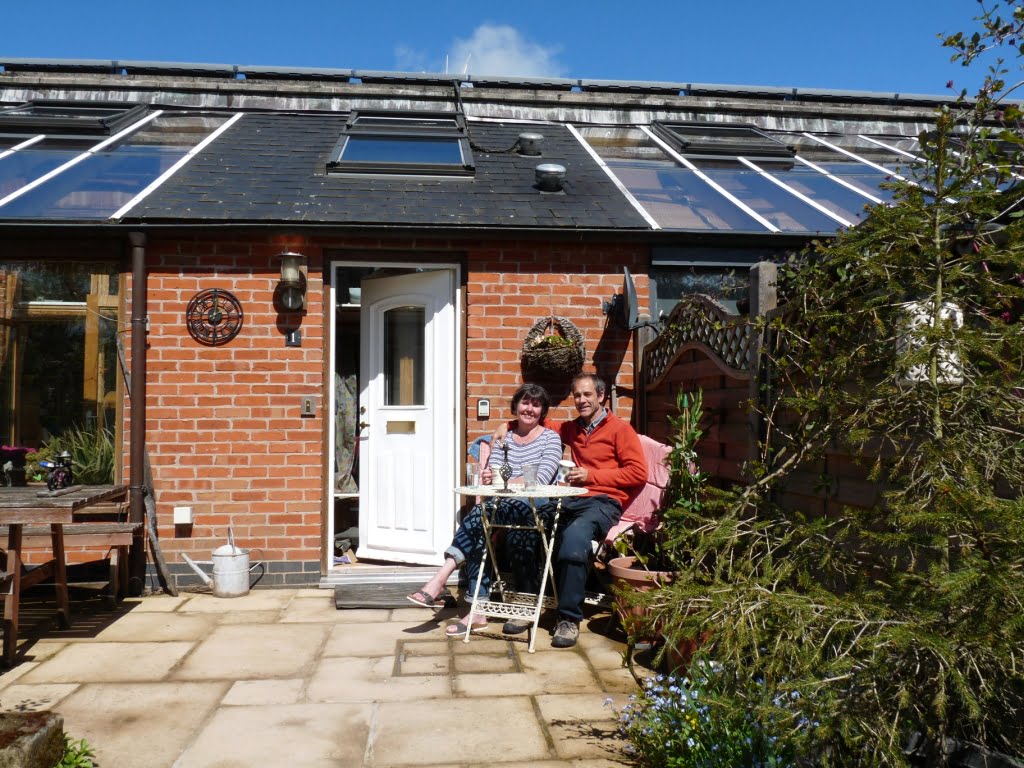
So on a day like today we shut the triple-glazing between the living space and buffer zones, along with curtains and shutters if we are out and about, to keep out warm air and solar gain; and let the thermal mass soak up the heat when we are around the house. We have built passive ventilation into our buffer zones – otherwise known as skylights in the conservatory and porch area – which are vital to keeping the temperatures in those spaces comfortable.
Given the warnings yesterday from the Committee on Climate Change, we think cooling, or overheating, is an issue that needs addressing as part of the government’s home energy strategy. It should not be an add-on as there can be a conflict between approaches that keep heat in during winter and keep it out over summer.
The positioning of insulation in a construction element was completely disregarded by SAP up to and including SAP2005, and continues to be ignored by RdSAP. But it is essential if you want to get the heat storage benefits of thermal mass throughout the year for cooling, heat storage & release. Our walls, floor and roof could have the insulation placed on the inside, which would give exactly the same U-Values and hence RdSAP result, but completely different and appalling thermal performance of the house as a whole in warmer weather. Instead of being absorbed into the thermal mass, the passive solar gain would continue to raise the temperature until vented in some way.
Even though this is beginning to be recorded by SAP, RdSAP does still not differentiate between internal and external solid wall insulation. Neither assessment reflects the benefits in their overall assessment of thermal comfort. If the Government wants to prepare homes for the 21st century, and beyond, these tools will need to both recognise and reward the way external insulation can “lock in” the mass of the walls to deliver summer cooling and winter heating.
One of our longest-standing residents reflects on her time at HHP….
This is the 20th year since we joined HHP. We had recently returned from volunteering in Namibia and felt that sustainable development needed to start in the affluent West. We had relocated to Nottingham as I had a medical job there and Simon was looking after our small son Luke and looking for some way of using his engineering skills and doing it sustainably. By chance he came across HHP who were looking for a family to join them and the rest is history!
In those days (1995) I think we were more about sustainable and autonomous housing and climate change was not such an obvious issue but of course that has all changed and Simon now spends a great deal of time thinking about Renewables although our core business of demonstrating and promoting zero energy and sustainable housing continues and has lost none of its relevance today.
We moved into our brand new house in February 1998 after 18 months in a caravan with by then 3 small children. Simon had contributed to the self-build and being on site allowed him to juggle the family and building whilst I went off to a warm comfortable hospital every day! Our neighbours at the time were in a similar position which allowed some complementary childcare and a lot of mutual support!
Over the 20 years the Project has grown in so many ways. We had not realised the amount of interest it would generate with about 30,000 visitors, a significant amount of media interest and a small business that has continued to promote sustainability and provide employment for some of the residents.
Families have come and gone and we are now the last original family. Our children are grown up and Flo who was born when we were in the caravan is doing A levels and considering her future. It is perhaps not surprising that Luke is studying permaculture and small-scale organic horticulture in Leeds and Naomi is down in Falmouth studying Environmental Science. Their childhood in this wonderful site has been spent in the woodland and lake, in a small community of children and adults where they have had the freedom to explore and learn in safety. Parenting them has been easy. It is a pleasure to see other small children growing up and enjoying this space that we have helped to create.
As old families have moved on it is sad to lose that collective memory of the first days and the struggle to get planning permission and the houses built. We will be the last to remember why we did things this way or that and why that particular phrase in the secondary rules was written that way. But new families have brought in fresh energy and ideas and keep the direction of the business gently changing depending on interest, skills and available time.
Simon and I have no plans to leave and this lifestyle and place is perfect for us. The apple trees are in blossom and the new plants in the polytunnel are thriving and ready to go out. As the spring sun floods the conservatory after earlier rain, I am as excited as ever to throw open the doors to the bedrooms and know that the temperature in the house will stay in the low 20s until November.
After 20 years here our lives will change as the children leave and we have a bit more time for ourselves. More time to spend on the land, more time to sort out 20 years of childhood paraphernalia and more time to sit in the kitchen, conservatory, garden or lakeside depending on the weather and the season just enjoying this extraordinary place we helped to create!
Hockerton Housing Project is featured in a new book, The ‘One Planet’ Life: A Blueprint for Low Impact Development. The guidebook has been written ‘for everyone on the path towards a way of life in which we don’t act as if we had more than one planet Earth. The book also represents a manifesto for a change in attitude towards land use’.
You can get a taster in this informative blog about our development by the author David Thorpe, who is also a founder and core group member of the One Planet Council, and former director of publications at CAT.
If you want to see it for yourself, come on our next tour.
A couple of weeks ago we hosted photo/video journalist John Robertson for a day to talk about life at Hockerton, and how we manage to live sustainably whilst enjoying all the comforts of the 21st century. He was particularly keen to hear about one family’s move from London and how they’d settled in.
It’s always a pleasure to show people round, and see the moment they ‘get’ we’re not a load of judgemental hemp-soled-sandle-wearing soap-dodgers, but that this is a lifestyle that makes sense on so many levels. JR definitely got it, as you’ll see in the film below – and no bribes were offered or taken!
Thanks to him and the folks at Barcroft Media for doing such a good job, with the help of our own overhead shots, and helping us get our message out to readers of the Mail, Telegraph, Green Building Press and multiple other channels.
Videographer / Director: John Robertson / Buzzpix Aerial Photography and Video, Producer: Amanda Stringfellow, Editor: Kyle Waters.
Back in June the Government published its most detailed research yet on electricity use in the home: Powering the Nation 2.
It’s returned to our minds with recent coverage of EU rules on vacuum cleaners.
We understand some people are concerned, but power consumption and performance are 2 very different (eco) kettles of fish, a case well made by this rebuttal from the EU.
A third dimension is creeping into the energy conscious consumer’s priorities alongside power use and performance: time. New time of use tariffs will emerge over the coming decade to try and manage down use during peak demand hours (4pm – 8pm) to avoid the higher financial and environmental costs of flexible supply. Alongside the risk that new tariffs will be no clearer than Economy 7, which leaves about 40% of users out of pocket, there is the risk that consumers will simply pay higher bills as the price for flexibility.
So, here’s the good news from that Powering the Nation report:
“More efficient appliances would make a bigger difference to the peak load than ‘load-switching’ per se”
This is why we need regulations on energy efficiency. Regulations address a lack of information in the market, and in this case they address a (highly understandable) lack of knowledge amongst consumers of the relationship between power use and performance. Of course, it takes time for those efficiencies to be felt in every home, with the potential need for help for fuel poor households, so in the meantime here at Hockerton Housing Project we are timing our flexible use such as our immersion heaters, white goods and the EV to match peak solar generation or off-peak supply hours, and are planning to investigate how to better match use to generation.
And finally, one household has got a cordless vacuum cleaner, one example of how batteries could transform the way and times we use energy. But it’s so useful that, whilst its energy use can be timed to cut financial and environmental costs per kWh, the total energy use could be much higher because it’s so handy. It’s never simple is it?!