Move to Gable Drive Hockerton Nottinghamshire Contact us Almost gone! SSTC now sold, HOWEVER THERE IS NOW 2024 A HOUSE FOR SALE IN HHP, FIND OUT MORE.
There is a unique opportunity to purchase one of the most energy efficient homes in the UK, nestled in the rural village of Hockerton, near the bustling country town of Southwell and next door to the Hockerton Housing Project a world-renowned sustainable development.
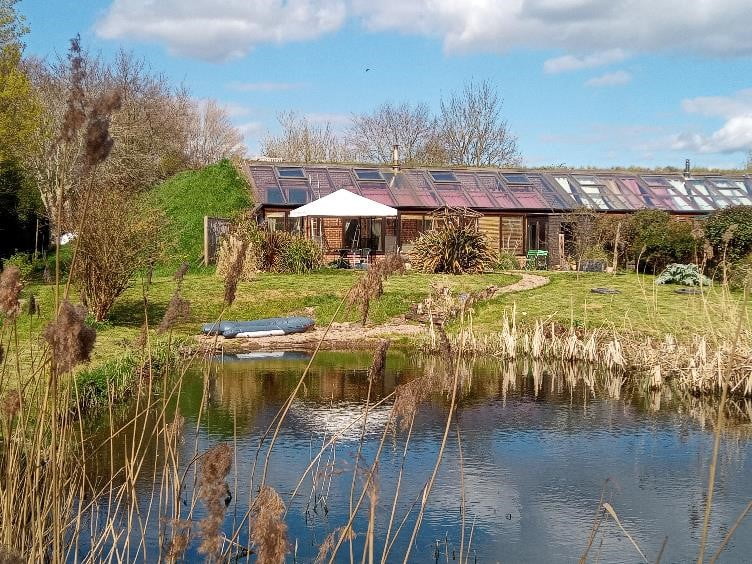
SOLD Eco home lake view Gables Drive Hockerton
This home offers a fantastic opportunity to live in a house fit for the future. Warm and comfortable living with built in resilience. The space is flexible and full of light with a very spacious conservatory to the south. The garden is landscaped, spacious and teaming with wildlife. The house sits close to other “eco” houses with a good social feel. The local pub is just a short walk away. Southwell just over the hill offers good shops, restaurants, schools and many other amenities within a thriving community. Full details available in the sale brochure here. The super insulated earth sheltered design works very well indeed at keeping bills to a minimum and the environmental impact low. It is a 2 or 3 bedroom home so suitable for singles to small families. It would be an ideal place to grow up in! So “How to buy an eco home in Nottinghamshire”,

Contact us now before it’s gone to arrange a viewing and put in your offer.
Property Location:
Gables Drive, Hockerton, Southwell, Notts NG25 0QU.
Tenure: 999-year lease with annual peppercorn rent in perpetuity.
Guide Price: Offers sought over £392 000 for quick sale.
According to The Move Market Last sold for £360 000 in 2016 and now worth £408 000

Eco homes or passive house or green houses come in many names but this is a very special opportunity!
How to buy an eco home in Nottinghamshire –
Do not delay Contact us now!
Video tour here
Sustainable construction – what is thermal mass? Lets have a look at what this means:
Lets start with what is Sustainable Construction?
Sustainability is the creation and maintenance of systems that meets the needs of the present without compromising the ability of future generations to meet their own needs.
There are three key interacting aspects to sustainability: economic, environmental and social. If one of these is lacking, people will find it difficult to meet their needs.
The challenge for self-builders or any new-build is keeping costs of the build under control, but it is important to not let short-term costs deter you from making long-term savings from lower energy and water costs.
The principles of high thermal mass and passive solar gain work in HHP homes to eliminate the need for artificial heating. It also underlines the priority we give to helping people develop and deliver low budget, low tech and buildable designs.
What is thermal mass?
‘Thermal mass‘ describes a material’s capacity to absorb, store and release heat. For example water and concrete have a high capacity to store heat and are referred to as ‘high thermal mass‘ materials.
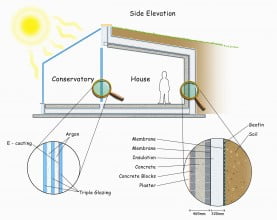
Thermal mass acts as a thermal battery. During summer it absorbs heat during the day and releases it by night keeping the house comfortable. In winter the same thermal mass can store the heat from the sun and release it much later, helping the home stay warm.
Thermal mass is not a substitute for insulation. To be effective, thermal mass must be integrated with appropriate design techniques such as areas of glazing facing the appropriate directions, tight construction and insulation on the outside of the mass.
So how does this work?
Thermal mass reduces the need for any form of whole house heating in the Hockerton homes. The house construction of concrete creates thermal mass because it is insulated on the outside. The mass stores the energy from the sun, our bodies and incidental gains to keep the houses at a constant temperature throughout the year typically around 20 degrees. In the summer the houses feel cool and in the winter they feel warm.
More information on Thermal performance and the construction of HHP houses are available here and from the concrete centre.
If you would like to find out more click here.

Sustainable construction – what is thermal mass and how does it help
We can help you apply those principles to your project – whether it’s a new-build or renovation of an existing home.
Current house sales
Previous house sales
Hockerton Housing Project’s passive solar eco house number 2 was sold in 2020
(WE HOLD A WAITING LIST. IF THIS IS SOMETHING YOU WOULD BE INTERESTED IN, IN THE FUTURE please contact us.)
Previous sale information 2020 for a 4 bed house: It is one of the five private homes on this sustainable co-housing development. It comes with shared access and use of renewable energy systems, rainwater harvesting, lakes, woodland and 6 acres of land, with a further 8.5 acres on an agricultural lease.
£460,000

Kitchen of house for sale at Hockerton Housing Project
Click here for further information about the current house sales
Residents benefit from very low bills, onsite renewable energy systems and rainwater harvesting, and access and use of 14.5 acres. The homes and their gardens are private, with all households sharing in the management of the surrounding land and facilities, and the onsite business that provides an income for residents through its range of services relating to sustainability.
Location
The development is in the Nottinghamshire village of Hockerton, 1.5 miles from the market town of Southwell and 7 miles from Newark, with its 75 minute train link to London. The village has a pub and an active community spirit. Schools include the Lowes Wong Infant and Junior School and the excellent Minster School. Southwell is a bustling historic town with a useful range of shops, two weekly markets, and regular festivals throughout the year.
This is a private sale, please contact us if you would like to be put in touch with the sellers.
You can view the EPC here, but please note the method behind it cannot cope with the property’s lack of heating – we have the past 20 years records to prove it!
 Hockerton Housing Project in Nottinghamshire is celebrating its 20th anniversary this year. To mark the occasion it welcomed the Chairman of Newark and Sherwood District Council, Councillor Keith Walker, to unveil a plaque commemorating the legacy of the three parties. The Project would not have got out of the ground without an enlightened landowner, pioneering architects and a visionary local authority, and it is their legacy that Hockerton Housing Project is celebrating this week with representatives from local business and the local authority.
The homes at Hockerton Housing Project (HHP) use 20% of the energy used by a similar-sized house built at the same time, for the same price. There is no loss of comfort. Instead of fossil-fuelled central heating the homes are built to absorb heat from the sun over the Summer and early Autumn, which is then released over the winter. This keeps the homes cool in summer and warm in winter. Air quality is maintained through the use of heat-recovery ventilation and water heating costs are reduced through the use of a thermal store.
By reducing the energy demands of the homes, the Project is then able to meet much of its remaining energy demand through onsite wind turbines and solar PV. This idea caught on in its wider community. In 2009, the parish of Hockerton invited the trading arm of HHP to manage the installation and management of a community-owned wind turbine. This now generates power equivalent to that used by the village and raises funds for the sustainable development in the community. As a pioneer of community energy HHP has since run a range of courses and support services for communities and land-owners installing and maintaining community-scale systems.
These ongoing and expanding benefits would not have happened without support from the original landowner, pioneering architects and a supportive local authority.
Roy and Eileen Martin were the original landowners of the land on which the Project is sited. On purchase, it had little environmental benefit. It was a monoculture of grass, mainly used for grazing due to frost pockets, boggy areas and exposure to wind. When their son, Nick, proposed a sustainable development incorporating organic land management alongside eco-housing they gave their support. Over time this formalised into a governance framework of a 999 year lease with a peppercorn rent, provided the Project continues to meet its social, environmental and economic obligations.
Professor Brenda Vale and Doctor Robert Vale are architects, and now world-renowned experts, in the field of sustainable housing. Their design framework for eco housing is a simple and cost-effective combination of high thermal mass, to store and release heat; super-insulation, to retain that heat in the structure of the home until it is needed; and designing for the environment. Whilst working at University of Nottingham they built a zero carbon autonomous town house fitting to the historic town of Southwell. Serendipitously they had used local builder Nick Martin who was looking for architects to help him and a group of friends with their ideas for Hockerton. They used the same design framework, but adapted it to the greenfield setting. By covering the main structure of the homes in a hill, the Vales were able to limit the loss of land from nature; by orientating the homes to face South, the Vales were able to maximise the solar gain used to heat the homes; and with the Vales’ design requirement to use rainwater harvesting to meet all water needs, water reservoirs were introduced that improve the habitat for a range of flora and fauna.
David Pickles OBE was chief architect and energy manager for Newark and Sherwood District Council in the 1990s and 2000s, whose work with others generated a national reputation for innovative energy work in the East Midlands [1]. He understood the vision and the need for research and development of zero carbon homes. He worked with Hockerton Housing Project to develop a framework that ensured the greenfield development would benefit rather than harm the green environment. The resultant section 106 agreement remains a cornerstone of the Project’s activities 20 years on. In particular the requirement to generate employment instigated the trading cooperative that today provides a range of educational and advisory services to a range of individuals and organisations, along with an income for residents [2].
Councillor Walker has visited the Project over the years – during their initial build and when they were first occupied and was interested to see how it was continuing the original vision set out with Newark and Sherwood District Council in a section 106 agreement. He congratulated the residents, past and present on what they had achieved. Guests also heard from Stormsaver, Tarmac and Nottingham University about their interest in the Project’s approach to sustainable housing and water systems, with many questions about why such an affordable approach wasn’t being taken up by developers.
Around 2000 people a year visit the Project each year; it has featured in thousands of green building and energy publications and informed millions more through broadcast media; and is studied by architectural and engineering students across the UK and beyond. But the Project remains, primarily, home to 5 families and their shared interest in continuing the legacy of an exemplar sustainable development that could, and should, shape the design of housing fit for the 21st century.
 Planning permission has been granted for 9 houses designed by Hockerton Housing Project.
The earth-sheltered homes will be built on a greenfield site on the edge of a rural village. It is (rightly) not easy to get permission to build on such sites, and the owner had to take the case through to Appeal after the local Council refused permission.
One way to get planning permission on greenfield sites is to demonstrate outstanding architectural merit through an innovative design. This is notoriously difficult as the bar is constantly being raised, and features such as new technologies, complex shapes, height, and overall size add to land, design, build and running costs.
Our approach is the opposite. Our designs are simple and have exceptionally low running costs. However, we argue that we remain innovative so long as measures such as SAP and Passivhaus do not recognise our use of super-insulated thermal mass as a heat store.
The Appeals Inspector for this application recognised the many benefits of the form of our design but felt it was too simple in its aesthetic to get planning permission on the basis of architectural merit, and there was insufficient innovation in his view. That raises questions as to whether planning policy deters affordable housing in rural areas, but there is a positive in that the affordability of our design and the wider scheme remained pertinent to the final judgement.
Permission was granted on the basis that the greenfield site is not isolated and as such the homes would support the economic and social vitality of the village due to their energy saving credentials, size, appeal and affordability to young people and downsizers. Both the Council and the Appeal also recognised that the homes, with their earth-sheltering, related landscaping and reed beds will improve the biodiversity of the site.