Forward from Luke: Hey! I’m excited to host Ed Revil (traveling up from his small holding in Swansea) at the Meanwood Community Farm in Leeds this Thursday 21st Nov 18-20.00 it will be an inspiring and challenging presentation from his 20 years experience of building soils, capturing carbon and producing food using DIY appropriate technology to make bio char. Hope to see you there! Luke
In this folder there are a 14 climate change related lesson plans that will encourage students to think more sustainably. I have summarised these lesson plans so that they can be easily used for teaching purposes when school groups make site-visits to Hockerton Housing Project. For example:
Lesson 2 – Donald Trump Climate Quotes and Climate Denial
Summary:
Fake News or ‘What Donald Trump Said’ activity – great activity about 15-20 mins long
BBC News article on psychology of climate change denial. Students need to read this and complete an activity sheet asking them to summarise the article.
Google Docs Outline:
Starter: Trump or Fake News – Show students the quotes from Donald Trump relating to climate change. Ask the students to decide whether the quote is ‘Trump’ or ‘Fake News’. Use the information sheet to elaborate on the meaning of his words. Ask students their opinion of Trump’s attitude? Should he be allowed to have these views?
Scientific Consensus – Why does Climate Denial still exist? Explain the animated graph showing temperature models for a variety of organisations around the world all showing a similar trend. 98% of scientific evidence suggests recent climate change is manmade. Is there still a debate?
News Article – Brain Biases. Direct students to read the BBC news article. Using the worksheet students should read and then reread, pulling out different pieces of information as they go.
What’s the main reason for our inaction? – Students should rank the suggested factors and in pairs, develop reasons for why they think this might be the most powerful factor.
Open the document below too see my summary of all 14 lesson plans.
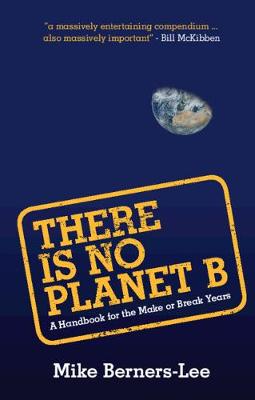
This is a great book which gives the carbon facts about our consumption in a relatively easy way to understand. Mike has covered all aspects of life including a detailed first chapter on food but also travel, money, investment and values. Whilst he is very clear about what needs to be achieved to prevent 1.5 degrees of climate change he offers choices about our consumption in a way that left me feeling empowered and not guilty.
This is an essential read for us all! My response to this book has been to give a copy to all in the executive team at my hospital and to all of our current cohort of medical students. Those with the power to make high value decisions and the senior leaders of the future need to be thinking about this. In between , each one of us can use this book to guide us to reduce our carbon emissions urgently. I urge you to buy it, read it and pass it on to someone else.
Helena Tilley
Synopsis
Feeding the world, climate change, biodiversity, antibiotics, plastics – the list of concerns seems endless. But what is most pressing, what are the knock-on effects of our actions, and what should we do first? Do we all need to become vegetarian? How can we fly in a low-carbon world? Should we frack? How can we take control of technology? Does it all come down to population? And, given the global nature of the challenges we now face, what on Earth can any of us do?
Fortunately, Mike Berners-Lee has crunched the numbers and plotted a course of action that is practical and even enjoyable. There is No Planet B maps it out in an accessible and entertaining way, filled with astonishing facts and analysis. For the first time you’ll find big-picture perspective on the environmental and economic challenges of the day laid out in one place, and traced through to the underlying roots – questions of how we live and think. This book will shock you, surprise you – and then make you laugh. And you’ll find practical and even inspiring ideas for what you can actually do to help humanity thrive on this – our only – planet.
Publisher: Cambridge University Press ISBN: 9781108439589 Number of pages: 302 Weight: 380 g Dimensions: 216 x 138 x 17 mm
Its important for movers and shackers to read this book. We gave a copy to our MP at the Mass Lobby in London. Other people had opinions too!
Hockerton Housing Project’s passive solar eco house number 2 was sold in 2020
(WE HOLD A WAITING LIST. IF THIS IS SOMETHING YOU WOULD BE INTERESTED IN, IN THE FUTURE please contact us.)
Previous sale information 2020 for a 4 bed house: It is one of the five private homes on this sustainable co-housing development. It comes with shared access and use of renewable energy systems, rainwater harvesting, lakes, woodland and 6 acres of land, with a further 8.5 acres on an agricultural lease.
£460,000
Kitchen of house for sale at Hockerton Housing Project
Click here for further information about the current house sales
Residents benefit from very low bills, onsite renewable energy systems and rainwater harvesting, and access and use of 14.5 acres. The homes and their gardens are private, with all households sharing in the management of the surrounding land and facilities, and the onsite business that provides an income for residents through its range of services relating to sustainability.
Location
The development is in the Nottinghamshire village of Hockerton, 1.5 miles from the market town of Southwell and 7 miles from Newark, with its 75 minute train link to London. The village has a pub and an active community spirit. Schools include the Lowes Wong Infant and Junior School and the excellent Minster School. Southwell is a bustling historic town with a useful range of shops, two weekly markets, and regular festivals throughout the year.
This is a private sale, please contact us if you would like to be put in touch with the sellers.
You can view the EPC here, but please note the method behind it cannot cope with the property’s lack of heating – we have the past 20 years records to prove it!
One of our residents is a keen upholsterer and last year, after using some beautiful fabrics, many of them already sourced from ends of rolls, she started to wonder what to do with the small offcuts.
By happy coincidence a friend introduced her to the idea of Furoshiki and gave her a copy of ‘How to be a craftivist‘ in the same week she read about the problems that glitter and metallic paper cause for recycling centres, and an idea bubbled up for some craftivism.
Metallic and glittered papers may add a sparkle under the tree but pose a challenge for recycling. Metallic paper has to be picked out of the conveyor belts, adding to the costs of handling the waste. Glittery paper is more likely to be missed by the pickers, and ends up reducing the quality of the output, and with it the options for its use. Ultimately this adds to the cost of recycling or to the costs of the products that are made from recycled paper.
With all this in mind, a small group of volunteers made fabric wrapping to gift in our communities. We made and gave out wraps and fabric pouches made from off-cuts of fabric to 50 households in Hockerton and to the congregation of the Methodist Church in Southwell, our local market town. These gifts were given along with a letter explaining why, and a guide to their use from the Japanese Ministry of the Environment (see below). This is the essence of ‘craftivism’, that messages can be enclosed with useful and hopefully beautiful hand-made gifts, to remove the idea of criticism and instead surprise and hopefully bring a smile to faces whilst delivering a meaningful message.
Fabric wraps are not the only way to reduce the challenge to the recycling centres this Christmas. We can also use paper that is both recycled and recyclable; use ribbon that can be used year after year; and of course reuse paper. Surely it’s not just me whose only memory of my father with an iron is when he used to save and iron the wrapping paper on Christmas Day?!