Hockerton Housing Project is excited to announce it has released its own housing standard fit for the future world of zero carbon houses. It is called the Hockerton House Performance Standard and outlines the requirements that houses will need to be built to in order to achieve a sustainable low impact world. Unlike the Passivhaus standards these are free to use and go far beyond what Passivhaus can achieve. They are there to inspire!
Minister for Housing Nick Raynsford visiting Hockerton Housing Project
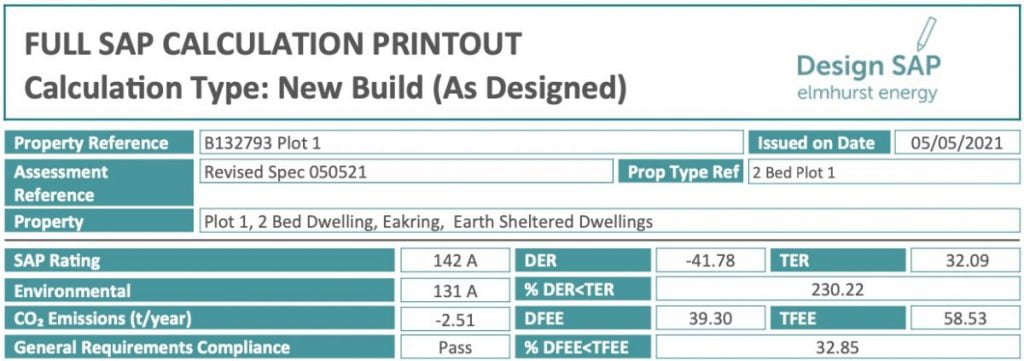
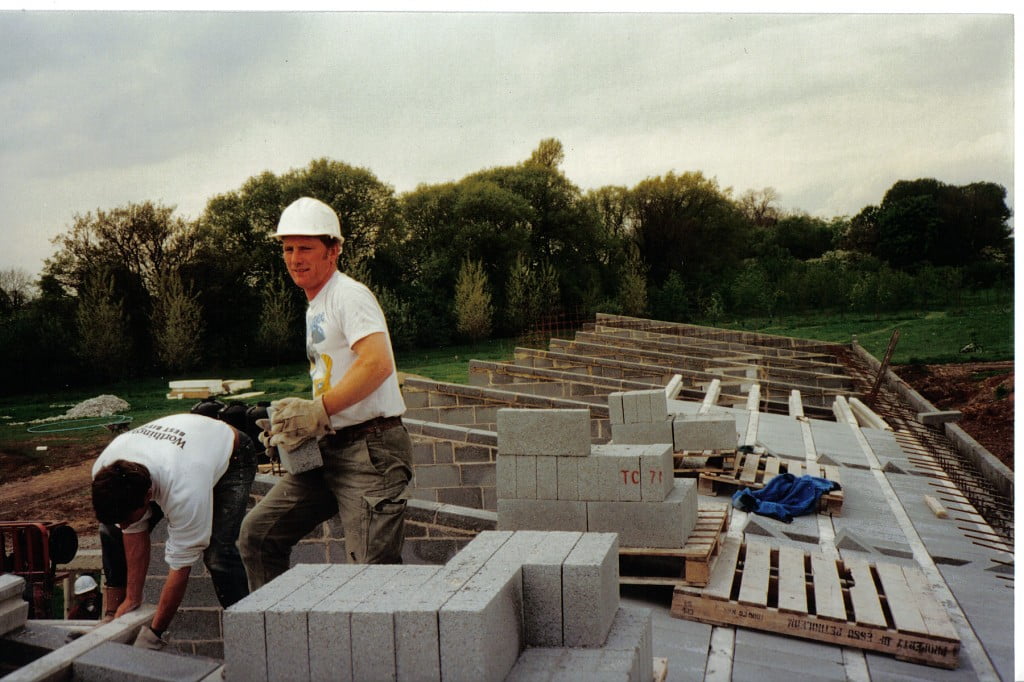
Since the visit of the Minister for Housing Nick Raynsford at our opening we have been pushing the boundaries of construction. Our latest development of nine houses is taking shape with the walls going up in Howgate Close, Eakring with a predicted SAP score of 142! Jerry Harrall is delivery the project and writing Howgate Close, blog.
Howgate close foundations
The UK is facing a crisis in housing which requires a dramatic change in how houses are designed and built to achieve the carbon reductions necessary to meet our climate change targets. With this in mind we are proposing standards of construction to inspire people to construct very high-performance houses factoring in embodied energy and within sustainable communities. The lifestyle of the people living in houses affects emissions of carbon significantly so cannot be ignored. A well-engineered house and designed community space will help inspire them to reduce their carbon emissions. Inspiration can lead to action given the right environment.
The imbedded House Performance Standards are performance based to allow individual designers and builders to create their own solutions. This should encourage creativity and enable future solutions to be incorporated in the finished houses.
These performance standards have been inspired by Dr Robert Vale, Professor Brenda Vale, Mr Nick Martin and the practical experience of the members of Hockerton Housing Project since 1993. They have drawn on General Information Report 53 produced for the Department of Environment Transport and the Regions by the Building Research Energy Conservation Support Unit. More recently the Leti “Net Zero Operational Carbon” targets have pushed us!
I am pleased to announce that in conjunction with Sustainable Hockerton we are now working with students who are solving the climate crisis on a regular basis.
We often get requests for help with dissertation projects in the form of requests to answer questionnaires or taking part in interviews. Sustainable Hockerton has agreed to fund some time to enable this support to occur. This is a limited resource so there will be a queuing system. In exchange for our input students will be requested to supply their finished work for publication on our website so that others can share their insights.
The climate crisis needs all hands-on deck to create a new way of living that does not destroy our atmosphere and decimate the wonderful species around us. Academic learning on how we do this is a critical step. Action based on good knowledge and understanding is now urgent for all of us.
As an example, Ellen Potter a student from the University of Sheffield ask us to be interviewed on the a topic she was assigned to written on. The title was How Do Cooperatives Put into Practice New Ecological Relations? HHP is a cooperative acting as a catalyst for change towards sustainable development and Sustainable Hockerton is a cooperative society developing community owned renewables and promoting sustainable living, so we were able to help her with this. Her report can be found here and is a good example of the in depth thinking necessary to start solving the problems we face. She has produced a thoughtful and well-argued case for cooperation and its ability to value what is not on a typical business balance sheet. working with students is very rewarding. This fits well with Dr Geeta Lakshmi and my work on community, value and power. This latter work may help facilitate financiers to understand arithmetically the wider value of capital within organisations. Link to paper and here.
How can better ecological relations be put into practice? We have been working on this. Here is a practical live project. Located at the western gateway to the Nottinghamshire village of Eakring, the site’s 10 acres have been taken out of agriculture production to provide nine homes within a managed wildlife area.
Eakring farmer and retired GP, Dr Chris Parsons, describes his project, Howgate Close as an opportunity to address some of society’s most pressing issues: rural housing shortage, climate change, soil restoration, carbon sequestration, biodiversity, water management and purification and community cohesiveness.
Howgate Close’s main objective is to provide local people who’ve been priced out of home-ownership, with high quality rented homes, offering low running costs, low maintenance and access to the open countryside. Also underway are plans to benefit the wider community with permissive access rights to part of the wood pasture.
Dr Parsons engaged the local ‘Hockerton Housing Project’ (HHP) to design ‘Howgate Close’ formally Eakring Eco Houses, using the design principles applied at HHP by its Architects, Professor’s Brenda and Robert Vale. Jerry Harrall is now also closely involved and writes more about the project here. It has an impressive SAP score you can see above, 142A.
To conclude. As Ellen says “humans and nature are not separate entities”.
There is a unique opportunity to purchase one of the most energy efficient homes in the UK, nestled in the rural village of Hockerton, near the bustling country town of Southwell and next door to the Hockerton Housing Project a world-renowned sustainable development.
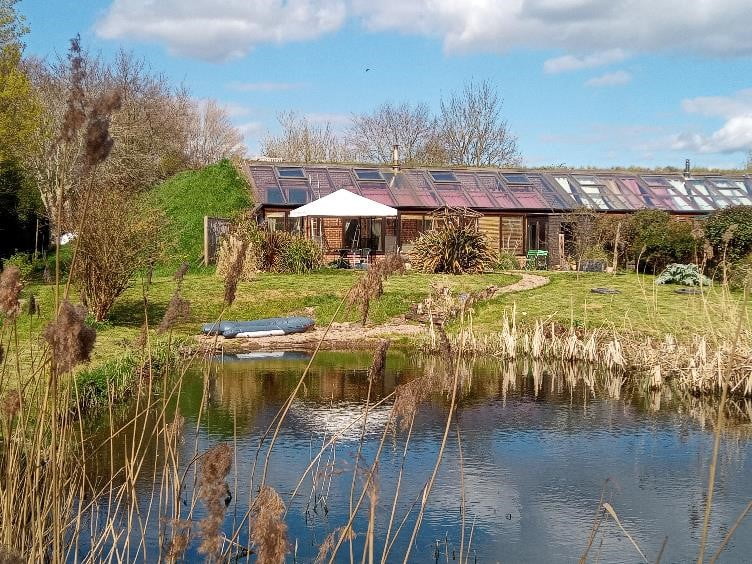
SOLD Eco home lake view Gables Drive Hockerton
This home offers a fantastic opportunity to live in a house fit for the future. Warm and comfortable living with built in resilience. The space is flexible and full of light with a very spacious conservatory to the south. The garden is landscaped, spacious and teaming with wildlife. The house sits close to other “eco” houses with a good social feel. The local pub is just a short walk away. Southwell just over the hill offers good shops, restaurants, schools and many other amenities within a thriving community. Full details available in the sale brochure here. The super insulated earth sheltered design works very well indeed at keeping bills to a minimum and the environmental impact low. It is a 2 or 3 bedroom home so suitable for singles to small families. It would be an ideal place to grow up in! So “How to buy an eco home in Nottinghamshire”,
Contact us now before it’s gone to arrange a viewing and put in your offer.
Sustainable construction – what is thermal mass? Lets have a look at what this means:
Lets start with what is Sustainable Construction?
Sustainability is the creation and maintenance of systems that meets the needs of the present without compromising the ability of future generations to meet their own needs.
There are three key interacting aspects to sustainability: economic, environmental and social. If one of these is lacking, people will find it difficult to meet their needs.
The challenge for self-builders or any new-build is keeping costs of the build under control, but it is important to not let short-term costs deter you from making long-term savings from lower energy and water costs.
The principles of high thermal mass and passive solar gain work in HHP homes to eliminate the need for artificial heating. It also underlines the priority we give to helping people develop and deliver low budget, low tech and buildable designs.
What is thermal mass?
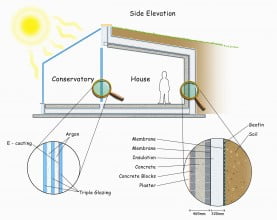
‘Thermal mass‘ describes a material’s capacity to absorb, store and release heat. For example water and concrete have a high capacity to store heat and are referred to as ‘high thermal mass‘ materials.
Thermal mass acts as a thermal battery. During summer it absorbs heat during the day and releases it by night keeping the house comfortable. In winter the same thermal mass can store the heat from the sun and release it much later, helping the home stay warm.
Thermal mass is not a substitute for insulation. To be effective, thermal mass must be integrated with appropriate design techniques such as areas of glazing facing the appropriate directions, tight construction and insulation on the outside of the mass.
So how does this work?
Thermal mass reduces the need for any form of whole house heating in the Hockerton homes. The house construction of concrete creates thermal mass because it is insulated on the outside. The mass stores the energy from the sun, our bodies and incidental gains to keep the houses at a constant temperature throughout the year typically around 20 degrees. In the summer the houses feel cool and in the winter they feel warm.
More information on Thermal performance and the construction of HHP houses are available here and from the concrete centre.
How does HHP manage its autonomous water systems at this time of year? As spring arrives, we are planning ahead. We have been pumping rainwater up to our reservoir for the last few months. It is very nearly full at the moment which feels great. We could be going into a dry period so may need it to last quite a long time. We have over 150 days in the waterbody which means self-sufficient living does not feel risky. I am fairly sure it will rain again in the next 5 months!
How many rainwater harvesting systems do we have at HHP? We have three systems one using the reservoir which supplies the bulk of our water, a second one supplying our drinking water and a third more informal system catching water from a shed roof to help supplement watering the plants. Having diverse systems helps you become resilient.
Top Ten Tips for Rainwater Systems
The top ten ways I would suggest to improve a rainwater systems:
Maintain the collection area so things like gutters are clear and clean. This means you will not lose water when it rains and your filters will have less work to do.
Keep a record of when you change the filters so that you know when they are due to be done next time.
Keep an inventory of the stock of filters so you are aware when you need to buy more.
As mentioned above have more than one system so if one fails you have another water supply to hand.
Regularly check the level of the store so you know how much water you have and adjust your behaviour should the tank become near empty.
If you plan to have a drinking water system, consider using concrete tanks instead of plastic tanks for storage as these help reduce the acidity of the water, limit food for bacteria and improve the taste.
Improve the resilience of your rainwater system by having a large storage tank. The amount you can store enables you to continue to use water between rainfall events. If you believe climate change is going to increase the variability of rainfall, then I would suggest you err on the side of caution and have as large a tank as possible. This will enable you to keep going for as long as possible with your own supply.
If you want to collect rainwater on a budget, I suggest buying a device that you fit into a standard down pipe that collects the water without any leaves etc. The water collected can be diverted to something as simple as a dustbin or other watertight container. You will supply yourself with a surprising amount of water. There is a local supplier of off the shelf systems called Stormsaver if you want a whole house system.
If you want to treat a large amount of water that is not for drinking, I suggest a slow sand filter. The name suggests it does not supply enough water but in fact they can. It all depends on the area of the sand and the depth of water above it.
If you are using a slow sand filter to treat your water be attentive to th
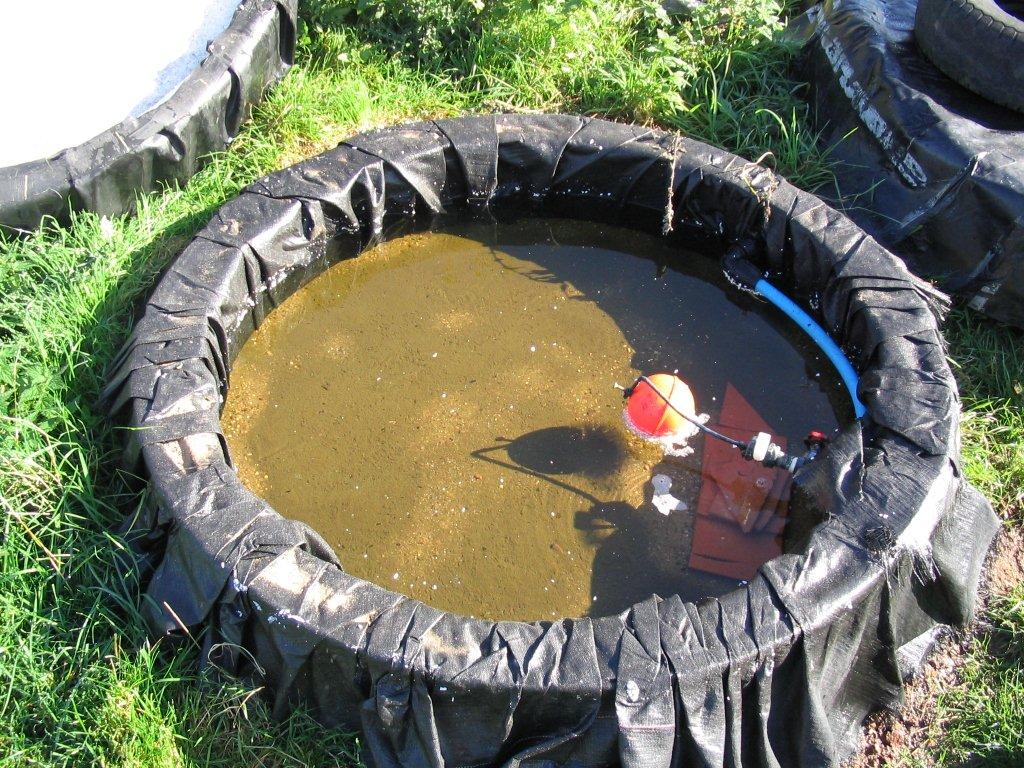
The water from out store is treated through this slow sand filter.
e top 25 millimetres of sand. It is this where the Schmutsdeke lives that does most of the water treatment. When the flow rate reduces you will need to reduce the thickness of this layer but I would suggest only removing about 10 millimetres so there is sufficient left to continue treating the water to some extent when you refill the filter.
Our Rainwater Systems Products
If you want more information, we have chapter written on our water systems which has good clear information and advice. Get chapter 7 here. We also have one on our unique hot water systems chapter 4 and one on the value of autonomy, chapter 12, which you may find useful.
People come on tours to see our systems and we get some good revues.
Subject: Today’s tour!
Dear Debbie, Matthew and Simon,
Thank you so much for the tour today. As always, it was a great way for the students to see and connect many different aspects of the material covered throughout their Environmental Management MSc, and a nice eye-opener for our international students, who are predominantly from India/Pakistan/East and West Africa (some of whom haven’t left their accommodation since they arrived in the UK in January!). Thanks, too for the added XR discussion. Hopefully, there’ll be a few more additions to the XR academy, now!
In other news, we’ve a new MSc course starting in September, on Renewable Energy Management. So it might mean even more attendees next time around, but perhaps by then we may be back in person.