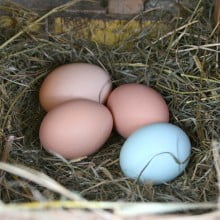
The Daily Express has featured Hockerton Housing Project to illustrate the benefits of sustainable co-housing developments…
As my car bumps along the potholes of the dirt track, the setting that unfolds before me is idyllic. Sheep graze lazily in the field to my left and a dozen or so chickens cluck like gossiping washerwomen as two young children excitedly collect eggs from the henhouse.
In the distance there are beehives while ahead ducks glide effortlessly across the still surface of a lake as a heron swoops in. Nearby a couple of men wearing fleeces are engrossed in conversation.
Though you may imagine that I’ve arrived in a sleepy country park or farmyard this in fact is a snapshot of life at one of the many so-called co- housing projects that are springing up all over Britain…
It’s an unconventional way of life that certainly wouldn’t be right for everyone but it’s impossible not to admire what they stand for at HHP. I can’t deny that as I drive back up the dirt track and out into the rat race again, I can feel my own stress levels kick back in.
Read the full feature, including an interview with residents Bill and Lou, here.
HHP has two completely separate autonomous rainwater systems – potable and non-potable. Since the completion of the houses in 1998, water from both systems has been tested regularly.
Our latest results (September 2011) indicate that our drinking water is perhaps cleaner than most branded bottled water! Could it really be that our filtered rainwater can be just as clean as the commercial products that line our supermarket shelves?
Broadly speaking there are two general categories of analysis; metals and bacteriological. In our case, the former remained consistently low with the exception of aluminium. Although previous years’ test results showed zero aluminium, September 2011 sample showed levels of 0.109mg/l. This figure is acceptable within the limits for small water systems (0.2 per mg/l) but larger water treatment plants are limited to 0.1 mg/l. Whatever limit we choose, we still feel this is unaccountably high – can anyone shed any light on this contaminant?
The bacteriological analysis proved to be both interesting and reassuring. Of all these, the Total Viable Count result (TVC) was of most interest. The test estimates the total amount of living organisms in a set volume of water at two separate temperatures; 22ºC (TVC 22C) and 37ºC (TVC 37C). The samples are left at that those temperatures for a period of 2 days and 3 days respectively, allowing any organisms present to populate the sample. These tests have been carried out on bottled waters with levels ranging between 42/ml and 32,659/ml for TVC 22C and between 3/ml to 1,950/ml for TVC 37C. Our drinking water, by comparison, showed 0/ml and 20/ml respectively. Even our aquaculture lake, which is full of fish, and receives liquid effluent from the reed bed, still manages to produce low results at TVC 22C 166/ml!
The irony is that even though we residents at Hockerton Housing Project consume approximately 2000 litres each per year of our harvested rainwater, we still have to provide paying visitors with bottled water! This is because, to comply with current health and safety guidelines, we would have to test our water on a monthly basis, currently around £1200 per year. Compare this with our visitors’ consumption of around 50 bottles of branded water per year, around £50 – the figures speak for themselves! (People on our tours also appreciate the tea, coffee and some wonderful local apple juice we supply for free!)
Two wind turbines have popped up around HHP. Patrick, an organic farmer in Hockerton, has installed a Gaia 11kW and another local farmer has erected an Enercon E33 near Eakring. SYNERGY the transition group in our neighbouring town of Southwell is also working on plans to put up a community owned Enercon E33 south of the town at Brackenhurst (part of Nottingham Trent University).
Closer to home Sustainable Hockerton’s turbine the Vestas V29 has had a fantastic December with well over 50 000 kWh produced! – A record for one single month. At over 23p per unit that makes a good income for the village! Whether community owned or farmer led wind harvesting seems to be catching on around us.
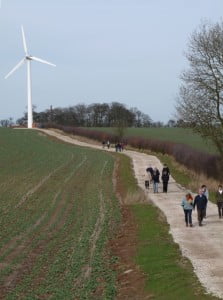 Hockerton’s community-owned wind turbine is beginning to reap financial rewards for both its shareholders and the village. It has just paid out its first interest payment to members of 5%, only 18 months after production started. It has also made money available to the village.
You can find out more of what Sustainable Hockerton have done on their web site and a take part video.
 Hockerton Housing Project are proud to announce that Luke Tilley, who has grown up at the project has been made captain of the Junior British Climbing Team. Luke is currently Junior British Champion for his age group and is now training hard to prepare for the World Championships in Imst (Austria) this summer.
Luke takes sustainability seriously and tries to minimise his carbon footprint despite his travel to European competitions. He is sponsored by Evolv, who are the first climbing shoe manufacturer to use a recycled rubber compound, and Prana, a climbing clothing company which powers its factory with wind energy (Natural Power Initiative).
From all at HHP, we wish Luke good luck in his future competitions and wisdom in his environmental choices!