Sustainable living is important in improving the health of the community, reducing carbon emissions and lowering environmental impact. Communities can take certain steps towards living sustainably such as switching to green energy suppliers to meet their electricity needs.
Homes, businesses and communities at large have been investing more and more in ecologically sound and sustainable ways of generating the energy they use. This has resulted in increased use of green energy suppliers to power homes and businesses across the UK.
Why it’s important to live sustainably
Living sustainably plays a significant role in protecting the environment and reducing wastefulness. When communities live sustainably, they reduce their carbon footprint and the number of toxins released into the atmosphere. This improves air quality while minimising air pollution. Sustainable living also helps conserve natural resources, ensuring communities use resources efficiently. This means future generations get to have resources to use to meet their energy needs.
What’s the impact of switching to green energy suppliers?
Switching to a green energy plan means that your energy comes from a low-carbon footprint source like wind and solar. In fact, making the switch to a green energy supply can save at least a tonne of CO2 from penetrating the atmosphere every year. While this amount varies depending on the size and nature of a business or home, green energy sources have an extremely lower carbon footprint, guaranteeing lower environmental impact. If communities switch to green energy power, carbon emissions can reduce by as much as 70% by 2050.
Leading green energy suppliers in the UK
Finding a green energy tariff for your home or business has become easier. There’s a growing list of green energy suppliers offering 100% renewable electricity to meet client energy needs. These include:
Good Energy Limited
Ecotricity
Click Energy
Orbit Energy
Pure Planet
Octopus Energy
Bulb
What’s the best green energy tariff?
There’s no one-size-fits-all when it comes to green energy supply. What may work for your home or business may not work for another since energy needs vary from person to person. The best green energy tariff for you depends on what metrics are vital to you, such as pricing, guidance and support.
We have been customers of both Good Energy Limited and Ecotricity for many years. Therefore, we can highly recommend them when it comes to green and renewable electricity. Their services are exemplary, and you can rest easy that their energy comes from a renewable source. Below, you’ll find an overview of these two suppliers:
Good Energy Limited
Good Energy Limited is UK’s first ever green energy supply company, bringing renewable electricity to homes, businesses and communities. The company aims to help you live sustainably by providing clean, green energy for daily use.
Ecotricity
Ecotricity is a complete vegan energy supplier, providing 100% renewable electricity. The company makes green gas from agricultural waste, ensuring clients get renewable energy from completely plant-based sources.
Ready to get started?
Here is one way to do it. The experts at Switch Plan are happy to help you navigate which green energy suppliers suit your home or business more. Simply give them a call at 0330 818 6223 for guidance and support.
I am moving on from my lecturing duties at Nottingham Trent University. There is now an opportunity for someone to take on this fulfilling role and the universities advertisement for it is below. Click for further the vacancy details. Please contact HHP if you want to discuss my experience of the work. Simon Tilley.
Nottingham Trent University
Hourly Paid Lecturer in Renewable Energy Technologies
Brackenhurst Campus
Job reference: 011117
Location: Brackenhurst Campus
Closing date: 11/12/2022
Salary : See special conditions
Employment type: Hourly paid/casual staff
Team: Environmental Science
School / Directorate : School of Animal Rural & Environmental Sciences
Special Conditions: £44.45 per direct teaching hour. This includes the following elements: teaching, preparation and marking of the scheduled programme of work. (A flat rate of £17.78 will be paid for completing one of the above elements of the schedule.)
The School of Animal, Rural and Environmental Sciences is an exciting multi-disciplinary environment for learning, teaching and research. We are seeking hourly paid lecturers for a range of courses within the Environmental Science Department. Our portfolio of undergraduate and postgraduate courses comprises subjects such as Horticulture, Geography, Conservation, Food Science and Environmental Science.
We are seeking to appoint an Hourly Paid Lecturer in the following area:
Renewable energy and energy policy
In addition to appropriate knowledge and experience, you should possess excellent communication and presentation skills and a willingness to contribute flexibly to teaching and associated duties on undergraduate courses in this area.
We need skilled lecturers to support students through delivery of a range of courses. You will work under the direction of the Head of Department and Course Leaders to deliver high quality teaching and learning to undergraduate students. Duties will include preparation, delivery and marking of work. You will be expected to deliver lectures and practical sessions, seminars and tutorials and may be asked to contribute to other areas of the School’s activities.
You will be able to demonstrate excellent interpersonal skills and have the ability to communicate ideas of a complex or technical nature to students effectively using a variety of teaching methods, have detailed knowledge of the particular subject area through significant teaching, and / or relevant industry experience.
If you have any specific queries in relation to these positions, please contact: Julia Davies 0115 848 5242
Interviews: Given the nature of these roles, interviews will take place throughout the year. The Head of Department or nominated colleague will be in touch following the submission of your application.
Please note this role does not meet the UK Border Agency requirements for sponsorship. The University is unable to apply for sponsorship for any applicant not eligible to work in the UK and therefore we cannot progress applications from candidates who require sponsorship under the Points Based Immigration System.
Master Class : The practicalities of
delivering zero carbon homes
Our Master Class is a one day fully catered training day to really help you get into the nitty gritty of how to build our type of houses. CLICK HERE TO BOOK
Who should attend
This event will be of particular interest to developers, self-builders, landowners, planners, architects, buildings services engineers, and other building professionals.
Why you should attend
Delegates will gain:
An overview of government targets for zero carbon homes and standards to meet.
An understanding of the impact of these targets for future development and what are the key principals for delivery of zero carbon homes.
Understanding of how to build the Hockerton House
Insight of the practicalities of achieving zero carbon housing.
An understanding of strategies and technologies that can be deployed.
Knowledge of diverse solutions for delivering a zero carbon or autonomous development including renewable energy technologies, and water systems (collection and waste), and how they can be incorporated into buildings.
An insight into what it is really like to live in zero carbon homes and to live sustainably.
Another wonderful, stimulating Master Class at Hockerton! Simon, Nick and
Deb, you put on an excellent day of top-line tutorial on cost-effective
autonomous house design and construction, which, in its fundamental
science can be applied to a whole range of house and building types. You
are aware that I was commissioned in 2008 to project manage a PPS7 type
house (now a para 79 house, under the current NPPF). I asked my
commissioned architect to attend one of your then Master Classes with me;
she applied the science of Hockerton to our project (a stunning stone-faced
mansion of 17,000 sq feet), which was designed (and audited) to perform,
together with all its services, to Hockerton standards. As a result of this, our
project application was passed by the Planning Committee 13 to 1 in favour
and only the second such house in history to be passed without going to
appeal.
Nick Woolley February 2020
I am pleased to announce that in conjunction with Sustainable Hockerton we are now working with students who are solving the climate crisis on a regular basis.
We often get requests for help with dissertation projects in the form of requests to answer questionnaires or taking part in interviews. Sustainable Hockerton has agreed to fund some time to enable this support to occur. This is a limited resource so there will be a queuing system. In exchange for our input students will be requested to supply their finished work for publication on our website so that others can share their insights.
The climate crisis needs all hands-on deck to create a new way of living that does not destroy our atmosphere and decimate the wonderful species around us. Academic learning on how we do this is a critical step. Action based on good knowledge and understanding is now urgent for all of us.
As an example, Ellen Potter a student from the University of Sheffield ask us to be interviewed on the a topic she was assigned to written on. The title was How Do Cooperatives Put into Practice New Ecological Relations? HHP is a cooperative acting as a catalyst for change towards sustainable development and Sustainable Hockerton is a cooperative society developing community owned renewables and promoting sustainable living, so we were able to help her with this. Her report can be found here and is a good example of the in depth thinking necessary to start solving the problems we face. She has produced a thoughtful and well-argued case for cooperation and its ability to value what is not on a typical business balance sheet. working with students is very rewarding. This fits well with Dr Geeta Lakshmi and my work on community, value and power. This latter work may help facilitate financiers to understand arithmetically the wider value of capital within organisations. Link to paper and here.
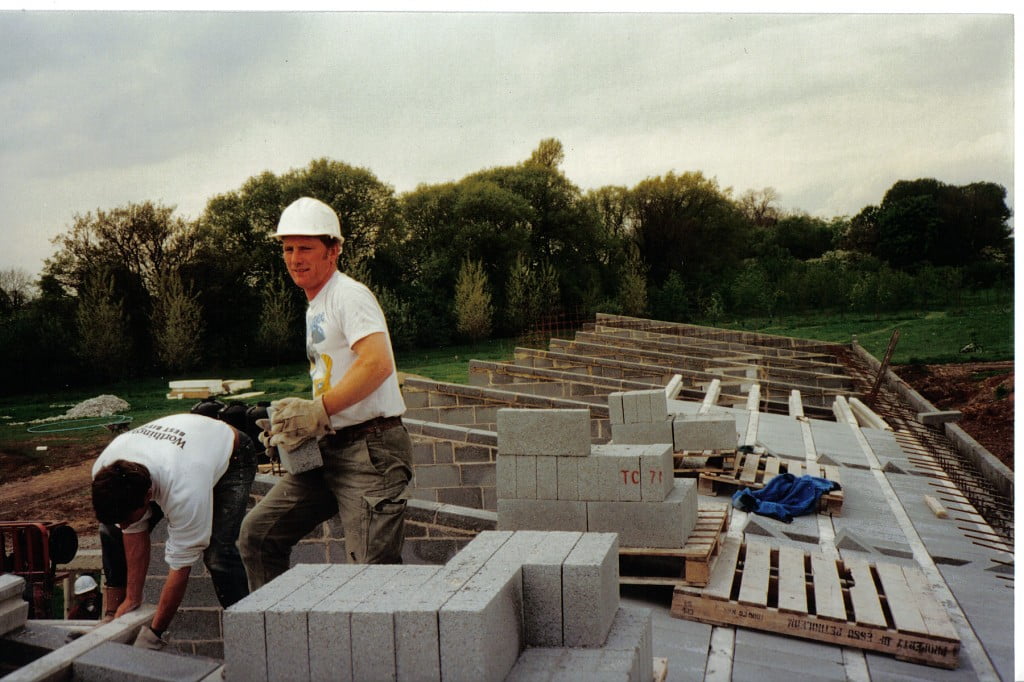
How can better ecological relations be put into practice? We have been working on this. Here is a practical live project. Located at the western gateway to the Nottinghamshire village of Eakring, the site’s 10 acres have been taken out of agriculture production to provide nine homes within a managed wildlife area.
Eakring farmer and retired GP, Dr Chris Parsons, describes his project, Howgate Close as an opportunity to address some of society’s most pressing issues: rural housing shortage, climate change, soil restoration, carbon sequestration, biodiversity, water management and purification and community cohesiveness.
Howgate Close’s main objective is to provide local people who’ve been priced out of home-ownership, with high quality rented homes, offering low running costs, low maintenance and access to the open countryside. Also underway are plans to benefit the wider community with permissive access rights to part of the wood pasture.
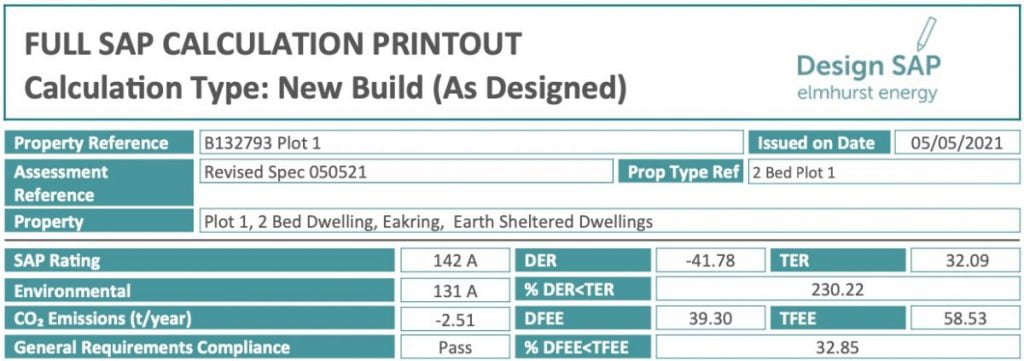
Dr Parsons engaged the local ‘Hockerton Housing Project’ (HHP) to design ‘Howgate Close’ formally Eakring Eco Houses, using the design principles applied at HHP by its Architects, Professor’s Brenda and Robert Vale. Jerry Harrall is now also closely involved and writes more about the project here. It has an impressive SAP score you can see above, 142A.
To conclude. As Ellen says “humans and nature are not separate entities”.
Sustainable construction – what is thermal mass? Lets have a look at what this means:
Lets start with what is Sustainable Construction?
Sustainability is the creation and maintenance of systems that meets the needs of the present without compromising the ability of future generations to meet their own needs.
There are three key interacting aspects to sustainability: economic, environmental and social. If one of these is lacking, people will find it difficult to meet their needs.
The challenge for self-builders or any new-build is keeping costs of the build under control, but it is important to not let short-term costs deter you from making long-term savings from lower energy and water costs.
The principles of high thermal mass and passive solar gain work in HHP homes to eliminate the need for artificial heating. It also underlines the priority we give to helping people develop and deliver low budget, low tech and buildable designs.
What is thermal mass?
‘Thermal mass‘ describes a material’s capacity to absorb, store and release heat. For example water and concrete have a high capacity to store heat and are referred to as ‘high thermal mass‘ materials.
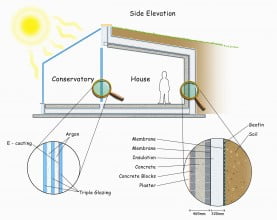
Thermal mass acts as a thermal battery. During summer it absorbs heat during the day and releases it by night keeping the house comfortable. In winter the same thermal mass can store the heat from the sun and release it much later, helping the home stay warm.
Thermal mass is not a substitute for insulation. To be effective, thermal mass must be integrated with appropriate design techniques such as areas of glazing facing the appropriate directions, tight construction and insulation on the outside of the mass.
So how does this work?
Thermal mass reduces the need for any form of whole house heating in the Hockerton homes. The house construction of concrete creates thermal mass because it is insulated on the outside. The mass stores the energy from the sun, our bodies and incidental gains to keep the houses at a constant temperature throughout the year typically around 20 degrees. In the summer the houses feel cool and in the winter they feel warm.
More information on Thermal performance and the construction of HHP houses are available here and from the concrete centre.