New homes and buildings in England will have to produce significantly less CO2 under new rules announced by the government to help the country move towards net zero. Published 15 December 2021
Changes to building regulations will help UK deliver net zero
New homes will have to produce around 30% less CO2
Important step for industry ahead of Future Homes and Buildings Standard in 2025
New homes and buildings in England will have to produce significantly less CO2 under new rules announced by the government in December 2021 to help the country move towards net zero.
Under the new regulations, CO2 emissions from new build homes must be around 30% lower than current standards and emissions from other new buildings, including offices and shops, must be reduced by 27%.
Heating and powering buildings currently makes up 40% of the UK’s total energy use.
Installing low carbon technology, such as solar panels and heat pumps, and using materials in a more energy efficient way to keep in heat will help cut emissions – lowering the cost of energy bills for families and helping deliver the UK’s climate change ambitions.
All new residential buildings, including homes, care homes, student accommodation and children’s homes, must also be designed to reduce overheating, making sure they are fit for the future and protect the most vulnerable people. Improvements to ventilation will also be introduced to support the safety of residents in newly-built homes and to prevent the spread of airborne viruses in new non-residential buildings.
The changes announced to the government’s Building Regulations, which set the standards in England for the design, construction and alteration of buildings, follow a public consultation and will come into effect from June 2022.
They will raise standards and are an important step towards a cleaner greener built environment, paving the way for the Future Homes and Buildings Standard in 2025, which will mean all future homes are net zero ready and will not need retrofitting.
Housing Minister Eddie Hughes said:
Climate change is the greatest threat we face and we must act to protect our precious planet for future generations.
The government is doing everything it can to deliver net zero and slashing CO2 emissions from homes and buildings is vital to achieving this commitment.
The changes will significantly improve the energy efficiency of the buildings where we live, work and spend our free time and are an important step on our country’s journey towards a cleaner, greener built environment.
Further information
Alongside amendments to the Building Regulations, there are 5 new Approved Documents:
There will be a 6 month period before the new regulations come into force on 15 June 2022. Transitional arrangements are in place which mean that if a building notice, initial notice, or full plans for building work are submitted to a local authority before 15 June 2022, then provided the building work commences by 15 June 2023, work on that individual building is permitted to continue under the previous standards.
As well as setting out measures for the 2021 uplift to the Building Regulations, the government response to the Future Buildings Standard consultation also sets out plans for the implementation of the Future Buildings Standard from 2025. This includes plans to start a full technical consultation on the FBS in 2025.
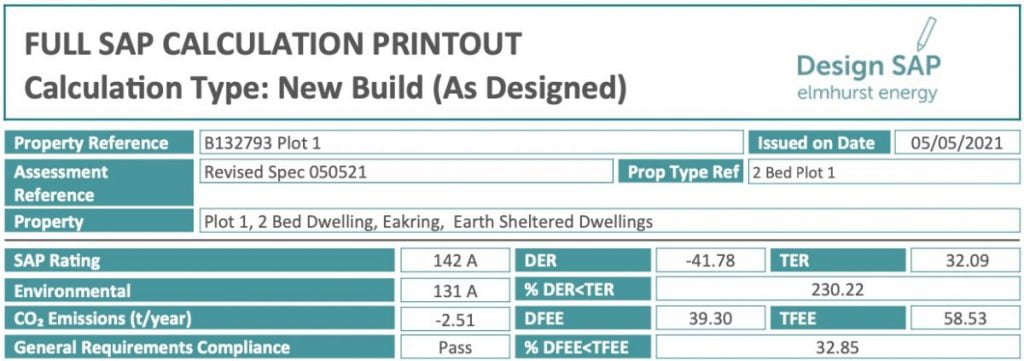
The new Hockerton type houses are coming on a pace in Eakring with the 4th out of 9 being plastered as I write. These houses will be the most well insulated in the UK SAP rating 142! The complement very well the “Hockerton House Performance Standard” (HHPS) that we have just trademarked. Please don’t be put off by this. They are free to download and use. We want as many more houses built to the highest standards as possible to help tackle the climate crises. We only ask that out name is referenced in any build project. The HHP standard goes well beyond any current option – the bar has been reset to meet the challenges we face. This contrasts with COP26 as we see below. The standard aims to help and guide you to achieve sustainable housing without fossil fuel input but with community at its heart. Available free of charge from our shop.
I am delighted to report that the eco house in Hockerton that we advertised sold and contracts have been exchanged; sorry if this was an opportunity that you wanted but missed. We had a lot of interest and could have sold the house many times over. It shows there is a market for eco houses that is not being met. The Guardian agrees.
We help make climate friendly housing a reality for people that come to us for help. Here is some resent feedback on our consultancy service.
Absolutely spot on info, thanks very much. You understood exactly what I was getting at with my questions. Just the right amount of detail at this stage for us.
Intrigued to know why you changed your ventilation system fans to computer cooling fans – but that will do for another time. As you say, probably best to stick with a conventional system for now.
All the very best,
Neil
We offer guidance on your current home and new build consultancy service back up with full professional indemnity insurance.
I went to COP26 in Glasgow recently and was very heartened by the enormous numbers of people in the marches supporting action on the climate crises. I think these were under reported.
COP26 Fridays For Future March (Part of the 30 000 attendees)
Not good enough! This all leads to mass extinctions and unparalleled climate shocks.
If we pull together at three levels, we have a chance to avert this catastrophe. Personnel actions, actions in our workplace and persuading the politicians to deliver policies that give us a chance. What can you do? Top tips to save the planet in order of priority:
Write to your MP, the person that represents you, to make the planet safe for you and future generations by removing all fossil fuel subsidies. We must leave fossil fuel in the ground!
Ask your boss what your workplace is doing to tackle the crises. Have they installed renewable energy yet?
Turning the heating down on the thermostat and then add insulation to your house.
There are many more ideas and solutions here and more details on the houses in Eakring here.
Hockerton Housing Project is excited to announce it has released its own housing standard fit for the future world of zero carbon houses. It is called the Hockerton House Performance Standard and outlines the requirements that houses will need to be built to in order to achieve a sustainable low impact world. Unlike the Passivhaus standards these are free to use and go far beyond what Passivhaus can achieve. They are there to inspire!
Minister for Housing Nick Raynsford visiting Hockerton Housing Project
Since the visit of the Minister for Housing Nick Raynsford at our opening we have been pushing the boundaries of construction. Our latest development of nine houses is taking shape with the walls going up in Howgate Close, Eakring with a predicted SAP score of 142! Jerry Harrall is delivery the project and writing Howgate Close, blog.
Howgate close foundations
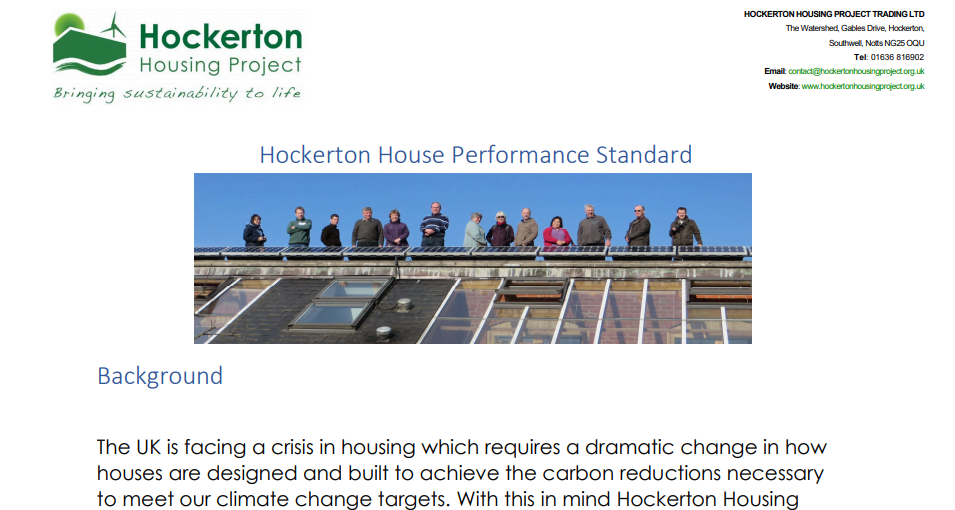
The UK is facing a crisis in housing which requires a dramatic change in how houses are designed and built to achieve the carbon reductions necessary to meet our climate change targets. With this in mind we are proposing standards of construction to inspire people to construct very high-performance houses factoring in embodied energy and within sustainable communities. The lifestyle of the people living in houses affects emissions of carbon significantly so cannot be ignored. A well-engineered house and designed community space will help inspire them to reduce their carbon emissions. Inspiration can lead to action given the right environment.
The imbedded House Performance Standards are performance based to allow individual designers and builders to create their own solutions. This should encourage creativity and enable future solutions to be incorporated in the finished houses.
These performance standards have been inspired by Dr Robert Vale, Professor Brenda Vale, Mr Nick Martin and the practical experience of the members of Hockerton Housing Project since 1993. They have drawn on General Information Report 53 produced for the Department of Environment Transport and the Regions by the Building Research Energy Conservation Support Unit. More recently the Leti “Net Zero Operational Carbon” targets have pushed us!
I am pleased to announce that in conjunction with Sustainable Hockerton we are now working with students who are solving the climate crisis on a regular basis.
We often get requests for help with dissertation projects in the form of requests to answer questionnaires or taking part in interviews. Sustainable Hockerton has agreed to fund some time to enable this support to occur. This is a limited resource so there will be a queuing system. In exchange for our input students will be requested to supply their finished work for publication on our website so that others can share their insights.
The climate crisis needs all hands-on deck to create a new way of living that does not destroy our atmosphere and decimate the wonderful species around us. Academic learning on how we do this is a critical step. Action based on good knowledge and understanding is now urgent for all of us.
As an example, Ellen Potter a student from the University of Sheffield ask us to be interviewed on the a topic she was assigned to written on. The title was How Do Cooperatives Put into Practice New Ecological Relations? HHP is a cooperative acting as a catalyst for change towards sustainable development and Sustainable Hockerton is a cooperative society developing community owned renewables and promoting sustainable living, so we were able to help her with this. Her report can be found here and is a good example of the in depth thinking necessary to start solving the problems we face. She has produced a thoughtful and well-argued case for cooperation and its ability to value what is not on a typical business balance sheet. working with students is very rewarding. This fits well with Dr Geeta Lakshmi and my work on community, value and power. This latter work may help facilitate financiers to understand arithmetically the wider value of capital within organisations. Link to paper and here.
How can better ecological relations be put into practice? We have been working on this. Here is a practical live project. Located at the western gateway to the Nottinghamshire village of Eakring, the site’s 10 acres have been taken out of agriculture production to provide nine homes within a managed wildlife area.
Eakring farmer and retired GP, Dr Chris Parsons, describes his project, Howgate Close as an opportunity to address some of society’s most pressing issues: rural housing shortage, climate change, soil restoration, carbon sequestration, biodiversity, water management and purification and community cohesiveness.
Howgate Close’s main objective is to provide local people who’ve been priced out of home-ownership, with high quality rented homes, offering low running costs, low maintenance and access to the open countryside. Also underway are plans to benefit the wider community with permissive access rights to part of the wood pasture.
Dr Parsons engaged the local ‘Hockerton Housing Project’ (HHP) to design ‘Howgate Close’ formally Eakring Eco Houses, using the design principles applied at HHP by its Architects, Professor’s Brenda and Robert Vale. Jerry Harrall is now also closely involved and writes more about the project here. It has an impressive SAP score you can see above, 142A.
To conclude. As Ellen says “humans and nature are not separate entities”.
One of our residents is a keen upholsterer and last year, after using some beautiful fabrics, many of them already sourced from ends of rolls, she started to wonder what to do with the small offcuts.
By happy coincidence a friend introduced her to the idea of Furoshiki and gave her a copy of ‘How to be a craftivist‘ in the same week she read about the problems that glitter and metallic paper cause for recycling centres, and an idea bubbled up for some craftivism.
Metallic and glittered papers may add a sparkle under the tree but pose a challenge for recycling. Metallic paper has to be picked out of the conveyor belts, adding to the costs of handling the waste. Glittery paper is more likely to be missed by the pickers, and ends up reducing the quality of the output, and with it the options for its use. Ultimately this adds to the cost of recycling or to the costs of the products that are made from recycled paper.
With all this in mind, a small group of volunteers made fabric wrapping to gift in our communities. We made and gave out wraps and fabric pouches made from off-cuts of fabric to 50 households in Hockerton and to the congregation of the Methodist Church in Southwell, our local market town. These gifts were given along with a letter explaining why, and a guide to their use from the Japanese Ministry of the Environment (see below). This is the essence of ‘craftivism’, that messages can be enclosed with useful and hopefully beautiful hand-made gifts, to remove the idea of criticism and instead surprise and hopefully bring a smile to faces whilst delivering a meaningful message.
Fabric wraps are not the only way to reduce the challenge to the recycling centres this Christmas. We can also use paper that is both recycled and recyclable; use ribbon that can be used year after year; and of course reuse paper. Surely it’s not just me whose only memory of my father with an iron is when he used to save and iron the wrapping paper on Christmas Day?!