 Planning permission has been granted for 9 houses designed by Hockerton Housing Project.
The earth-sheltered homes will be built on a greenfield site on the edge of a rural village. It is (rightly) not easy to get permission to build on such sites, and the owner had to take the case through to Appeal after the local Council refused permission.
One way to get planning permission on greenfield sites is to demonstrate outstanding architectural merit through an innovative design. This is notoriously difficult as the bar is constantly being raised, and features such as new technologies, complex shapes, height, and overall size add to land, design, build and running costs.
Our approach is the opposite. Our designs are simple and have exceptionally low running costs. However, we argue that we remain innovative so long as measures such as SAP and Passivhaus do not recognise our use of super-insulated thermal mass as a heat store.
The Appeals Inspector for this application recognised the many benefits of the form of our design but felt it was too simple in its aesthetic to get planning permission on the basis of architectural merit, and there was insufficient innovation in his view. That raises questions as to whether planning policy deters affordable housing in rural areas, but there is a positive in that the affordability of our design and the wider scheme remained pertinent to the final judgement.
Permission was granted on the basis that the greenfield site is not isolated and as such the homes would support the economic and social vitality of the village due to their energy saving credentials, size, appeal and affordability to young people and downsizers. Both the Council and the Appeal also recognised that the homes, with their earth-sheltering, related landscaping and reed beds will improve the biodiversity of the site.
Today the Committee on Climate Change published its ‘Next Steps for Heat Policy‘.
Heating and hot water for UK buildings make up 40% of our energy consumption and 20% of our greenhouse gas emissions. It will be necessary to largely eliminate these emissions by around 2050 to meet the targets in the Climate Change Act and to maintain the UK contribution to international action under the Paris Agreement.
It’s been widely welcomed for highlighting the stalling of Government policy in recent years. But one point sticks out to us in particular:
New-build. Buildings constructed now should not require retrofit in 15 years’ time. Rather, they should be highly energy efficient and designed to accommodate low-carbon heating from the start, meaning that it is possible to optimise the overall system efficiency and comfort at a building level.
The document expands on the potential for heat pumps and district heating, but where is the option of zero-heating? Why not build homes so they don’t need central heating? Whose heating system helps with summer cooling? And use solar PV and wind to top up efficient immersion heated water stores when renewable power supply surpasses time-critical demand?
It can be done, with existing technology and skills, at roughly the same cost as a new home built to building regulations alone, and here’s our energy use from the last 15 years, and a related temperature study to prove it.

The average energy use by the homes at Hockerton Housing Project has consistently been less than a third of that used by the ‘average’ UK household, and two-thirds of that demanded by the Passive House standard. 
So why is this approach not being followed more often?
- The Government’s preferred energy performance calculation (RdSAP and SAP) can’t calculate the benefits from interseasonal storage.
- There is no great commercial incentive to lobby for this low-tech and affordable approach. It profits residents rather than manufacturers or standard-setters.
- There’s an assumption that high thermal mass, in the form of concrete, is inherently bad. It’s not if it removes the need for heating, reduces maintenance, and increases the durability of the home. Parity with timber-framed homes is reached at about 20 years.
- That’s it.
And here’s the small print:
- 5 homes, averaging 2 adults, 1-2 children
- Increase use over time reflects increased home-working and children becoming teenagers. Savings in the general population are not mirrored as homes at Hockerton have always had energy efficient lightbulbs, sought the most efficient appliances, and had energy-aware residents.
- Temperature tracking was undertaken when home was drying out and with low occupancy in that first winter, so not a perfect study, and overheating is now minimised through shading of conservatory sunspaces during summer. Even before this, the instances of overheating met the requirements of the Passive House standard.
- When space heating is required, it can be delivered by small electric heaters with far lower capital and operational costs. Such occasional use is included in the usage graph above.
- The ‘average household’ energy use data is taken from UK Government statistics for household energy use.
- Readings are taken manually so some of the quarters are thirds, or very small quarters. One particular peak can be put down to our Christmas party in 2012! If anyone wants to fund/test automated reads, do get in touch!
Every 3 – 4 months we read our 50 power and water meters to check how we are doing in terms of consumption, generation and export.
Each household pays for their share of consumption relative to use, with any income from the export of renewable energy shared equally between us.
The resultant figures help us remain aware of our use, not least because we see it relative to (or in competition with?!) our neighbours. It also reminds us how well these houses perform. This can become easy to forget when the house is your home – until heatwaves like this week, when we could feel the difference as the thermal mass soaked up any heat that made it through shaded windows.
* Our average daily energy use was around 23% of a standard house (per house, not incl the garages).
* We exported 38% of what we generated, compared with 48% in the winter
* We earn around 4p for a kWh exported but pay on average 7.5p per kWh we use, so over the last 4 months we’ve missed out on energy worth £145.
* In the last 4 months we’ve generated the equivalent of 95% of our total household use (not including our shares in our community-owned wind turbine of course).
* And we are using 260 litres of water a day per house on average. Potable: non-potable is 1:11. This is a similar ratio to that in the first quarter but an increase overall. Average usage per person is 82 litres, compared with Code for Sustainable Homes Level 5 and 6 target of 80 litres – perhaps due to higher number of washes during peak vegetable gardening season!
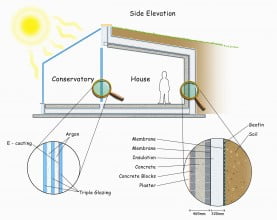
Have we ever mentioned how thermal mass keeps our homes warm in winter and cool in summer?
No doubt if you have visited us you’ve heard the stats and felt the benefit, but a day like today makes the benefits all the more evident.
The thermal comfort of our homes is met through the application of three key design principles:
- Thermal mass to store heat in the summer months to keep the home cool in summer and warm in winter
- Passive solar gain to reduce the need for space heating and artificial lighting
- Super-insulation and buffer zones to provide a reduced temperature gradient between the inside and outside of homes.
So on a day like today we shut the triple-glazing between the living space and buffer zones, along with curtains and shutters if we are out and about, to keep out warm air and solar gain; and let the thermal mass soak up the heat when we are around the house. We have built passive ventilation into our buffer zones – otherwise known as skylights in the conservatory and porch area – which are vital to keeping the temperatures in those spaces comfortable.
Given the warnings yesterday from the Committee on Climate Change, we think cooling, or overheating, is an issue that needs addressing as part of the government’s home energy strategy. It should not be an add-on as there can be a conflict between approaches that keep heat in during winter and keep it out over summer.
The positioning of insulation in a construction element was completely disregarded by SAP up to and including SAP2005, and continues to be ignored by RdSAP. But it is essential if you want to get the heat storage benefits of thermal mass throughout the year for cooling, heat storage & release. Our walls, floor and roof could have the insulation placed on the inside, which would give exactly the same U-Values and hence RdSAP result, but completely different and appalling thermal performance of the house as a whole in warmer weather. Instead of being absorbed into the thermal mass, the passive solar gain would continue to raise the temperature until vented in some way.
Even though this is beginning to be recorded by SAP, RdSAP does still not differentiate between internal and external solid wall insulation. Neither assessment reflects the benefits in their overall assessment of thermal comfort. If the Government wants to prepare homes for the 21st century, and beyond, these tools will need to both recognise and reward the way external insulation can “lock in” the mass of the walls to deliver summer cooling and winter heating.
 On 27 February we are holding our one day masterclass on the experience and learning from the development of Hockerton Housing Project.
The day offers a unique and practical insight into the delivery of the Project, covering its efficient design, energy systems, autonomous water services and proven performance. You can find the booking form at the bottom of this post, or here.
Why should you attend?
This event will be of particular interest to developers, self-builders, landowners, planners, architects, buildings services engineers, and other building professionals.
Delegates will gain:
-
an appreciation of the practicalities of building sustainably.
-
an understanding of strategies and technologies for ultra low energy building and ‘zero heating’ design.
-
a comprehension of the differences between high thermal mass build and lightweight timber frame construction.
-
knowledge of the potential solutions and strategies for delivering a zero carbon and autonomous development through renewable energy technologies, and water systems (collection and waste), and how they can be incorporated into buildings.
-
an insight into what it is really like to live in eco homes and to live sustainably.
Attending this event can contribute 6.0 hours towards your CPD requirements.
Programme
| 09.30 |
Registration and refreshments |
| 10.00 |
Introduction: Objectives for the day and introductions |
| 10.30 |
Hockerton Housing Project – Sustainability by design Simon Tilley, HHP |
| 11.15 |
Assessment Activity |
| 11.20 |
The construction process and practicalities Nick Martin, HHP |
| 12.05 |
Tour of one of the Project’s eco-homesNick Martin & Simon Tilley |
| 13.00 |
Lunch & networking |
| 13.35 |
Tour of the Sustainable Resource CentreNick Martin & Simon Tilley |
| 13.50 |
Developments inspired by HHP Nick Martin, HHP |
| 14.45 |
HHP autonomous services (including renewable energy & water systems)Simon Tilley, HHP |
| 15.30 |
Refreshment break |
| 15.35 |
Discussion session: Taking sustainability forward Nick Martin & Simon Tilley, HHP |
| 16.00 |
Close |
A lunch is included, please let us know any dietary requirements when booking.
The Tutors
Nick Martin
Nick Martin (BEd), a founding Project member, has a unique experience and knowledge of energy efficient housing. Nick led the build of the home of Prof. Brenda and Dr. Robert Vale, an autonomous townhouse with ‘net zero CO2’ emissions, delivered through low embodied energy, power from photovoltaic arrays and passive solar heating. Nick Martin then commissioned Dr. Robert Vale to design a rural hamlet of 5 earth sheltered sustainable dwellings to similar energy and environmental performance standards. Nick supervised this self-build project from August 1996 to Sept 1998.
Nick Martin now undertakes a range of related consultancy work, including new designs for ultra low energy housing and performance monitoring, as well as being directly involved in new eco-building projects. He is currently developing a 7 home ultra low energy affordable housing scheme in Hockerton.
Simon Tilley
Simon Tilley (M Eng, C Eng, M I Mech E) joined the project in 1995, after a background in Mechanical Engineering. This included spending two years in working for Voluntary Service Overseas (VSO) in Namibia.
He manages the HHP water & energy systems, including most recently the installation of an additional 6kW solar PV array. He lead the development and installation of the village Vestas v27 wind turbine and currently manages its operation. He undertakes a range of consultancy work and leads the Project’s educational work. Simon was also an Open University Associate Lecturer for the “Energy for a Sustainable Future” course and now lectures for Nottingham Trent University on Innovations in Energy.
Testimonials
I thoroughly enjoyed the day and it was very encouraging talking to people who had practical experience rather than just a grasp of the theory. Simon’s presentation on the principles was as clear as any I’ve seen, and the detailed discussion about construction and procurement challenges from Nick gave a practical edge to the day that you rarely get at other events.
Rob Annable, Architect, Axis Design Collective
The response was overwhelmingly positive. All felt that they had learned a great deal, it was great to see how enthused the staff members in the party were.
Paul Ellis, Chief Executive, Ecology Building Society
My main reason for visiting was that it’s easy for us industrialists and academics to sit behind our desks pontificating on low-energy housing,but to visit the people who have actually DONE it is invariably refreshing,and is always a good thing to do as a ‘professional sanity check’.
Dr Neil Cutland, Cutland Consulting Ltd
Terms and Conditions
Terms and conditions can be viewed on our website.




 Planning permission has been granted for 9 houses designed by Hockerton Housing Project.
