Hockerton Housing Project is looking for community energy projects who want to learn from our experience, to take advantage of a new Mentoring Fund.
The scheme is only open to applicants until 12 December 2013, but successful applicants will receive support through to March 2015. It’s a rare offer of funding for community projects that aim to:
· Generate energy
· Reduce energy use, and/or
· Manage and purchase energy
We have a range of experience to share, in terms of scale and technologies, in energy generation, reduction and management. And we are experienced in mentoring a range of projects, having run a similar service through the Energy Saving Trust, as well as our current advisory services.
We would be particularly keen to partner with multiple organisations to improve the cost-effectiveness of our application, with the programme starting with a joint workshop here at Hockerton before moving on to a mix of one-to-one support, community outreach and shared learning initiatives.
Find out more about the fund here, noting the eligibility criteria. If you are interested in the mentoring scheme please get in touch by 2 December, telling us a little about your organization and what you are trying to achieve in the next 18 months.
We look forward to hearing from you!
The HHP team

Let’s make stuff
We’re delighted to announce a new programme of seasonal and sustainable workshops for children and for adults, to give people the chance to get in touch with nature, recycle old furniture and decorate their homes. Take a look at our events page to see what’s on offer, and get in touch if you are a course provider looking for an inspiring eco venue to host your courses.
26 October Magic up your own broom!
23 November Kids’ Christmas crafts
8 December Weave a willow wreath
13 December Luxury wreath workshop
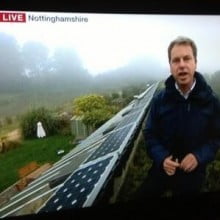 Today BBC Breakfast used Hockerton Housing Project (HHP) as the backdrop to their coverage of the latest Intergovernmental Panel on Climate Change’s report.
The IPCC has found that climate change is having a bigger impact than previously expected, and that temperature rises continue though they are slower than expected.
Science aside, HHP was delighted to be asked to show why sustainable living makes sense whatever your views on carbon and the climate.
The live broadcasts featured the zero carbon homes and renewable energy systems to show how action on carbon helps reduce energy bills, aids energy security, and galvanizes community spirit.
Simon Tilley talked through life at Hockerton Housing Project, “Our mission at HHP is to bring sustainability to life and what better platform than BBC Breakfast with its 7 million viewers? We were probably chosen because our homes look and feel different but the reality is that every home can become more sustainable: our approach to energy efficiency works in a townhouse, as seen in Southwell’s autonomous house; renewable energy is now more accessible thanks to the feed-in tariff and local community schemes; and it has been fantastic to see the resurgence of food-growing and the allotment movement.”
His daughter Naomi gave the most powerful line though. When asked by the presenter if she felt confident about the future, she replied “I’m not confident, I’m scared”. She later admitted that part of the fear was down to being interviewed live on national TV, but the line helped the coverage look beyond the current ‘debates’ to what we need to focus on – the legacy we leave for our children.
 South Brent’s community-owned Vestas V27 started production last week and 10th September sees 2355kWh on the clock.
It is great to this project go live, as it is very similar to our local Sustainable Hockerton turbine, which is also fully community owned, and we have close links to one of the Directors who is also a member of our scheme! We wish them every luck and success as the commissioning process gets under way.
Is it possible that we will now we start to catch up with the Danes where back in 2001 over 100,000 families belonged to wind farm cooperatives installing over 86% of the countries wind turbines? In Germany the national figure is 50% but in some regions 90% of installed wind capacity (700MW) is community owned1.
Power to the people!
1 Renewable Energy Focus Volume 14 issue 4
 Following the example of Hockerton’s community wind turbine, which was project managed by HHP, residents of Gamlingay in Cambridgeshire have installed a single 33m diameter wind turbine just outside their village.
This is a local project delivered by the community, for the community, that will significantly offset the village’s carbon footprint. Part of the profit will be used to provide a regular income to the village, as our own SHOCK turbine does, to be spent on local charities and community projects, hence the title ‘Community Turbine’.
We are particularly delighted to see their success as Gamlingay residents attended one of Hockerton Housing Project’s renewable energy masterclasses as part of their initial investigations, and used us as a model of how to deliver a community energy project.
If you are part of a community group looking to deliver a sizeable community renewable energy project in a rural area we would be pleased to assist with your feasibility study, using the support of the Rural Community Energy Fund, or sign up for our next renewable energy masterclass.